Introduction
Picture a consignment that leaves a spotless production line in good shape, sits in a third-party store for three weeks, then arrives at a retail distribution centre with damp cartons and a temperature breach nobody logged. The product was sound when it left. The storage let it down. For South African producers chasing retail listings and export orders, a solid warehouse compliance checklist is often the difference between stock that lands sellable and stock that gets turned away at the gate.
Food-grade warehousing is where quality is either protected or quietly lost, and buyers know it. That is why their due diligence rarely stops at the factory; they want to see how, and where, product is held before it reaches them. This guide sets out what “good” looks like, what to inspect, and how to run the checks without bringing operations to a standstill.
Table of Contents:
TL;DR: Key Takeaways
- A warehouse compliance checklist turns “looks clean” into documented, verifiable proof.
- Food warehousing South Africa sits under R638 hygiene rules; a Certificate of Acceptability is the legal baseline.
- Cold stores handling perishable exports must be PPECB-registered and re-inspected each season.
- Treat storage audits and warehouse inspections as routine, not a once-off panic before a buyer visit.
Why food-grade warehousing decides whether stock arrives sellable
Storage is the quiet link in the chain that buyers worry about most, because it is the stage they can see least. A producer controls the factory, but product often passes through a shared store, a transit hub, or a distribution centre before a buyer ever touches it. Each handover is a chance for temperature abuse, pest contact, or stock mix-ups. That is exactly why warehouse inspections have become a standard part of supplier due diligence rather than a nice-to-have.
The hidden cost of a warehouse that looks fine
A store can pass the eyeball test and still fail under scrutiny. Spotless aisles mean little if there are no temperature logs, no pest-control records, and no clear stock rotation. The risk usually hides in the gaps: a chiller that drifts overnight, a receiving bay left open to the yard, or a batch that cannot be traced back to a delivery note. A warehouse compliance checklist exists to drag those gaps into the open before they cost a listing.
Where South African storage conditions get tested
Local conditions add their own pressure, and any honest assessment has to account for them. Power supply reliability and backup-power planning remain a real operational consideration for any cold store, so buyers ask what happens when the grid wobbles. Long inland distances, warm summers, and busy ports all stretch the cold chain in ways that punish weak storage. A store that copes in winter is not automatically a store that copes in February.
What a warehouse compliance checklist actually covers
A warehouse compliance checklist is a repeatable set of checks that confirms a storage facility keeps food safe, traceable, and within spec. It is not one form filed away; it is a working tool used during storage audits, supplier onboarding, and routine self-checks. It covers structure and hygiene, temperature control, pest management, stock handling, and the paperwork that proves all of it. Done properly, it lets a buyer or an auditor reach a fair verdict quickly.
From “clean enough” to documented and verifiable
The shift that matters is from opinion to evidence. “The store is clean” is a claim; a signed cleaning schedule, calibrated thermometer records, and a pest-control logbook are proof. The food warehouse compliance checklist South Africa buyers favour leans hard on records, because records survive staff turnover and short memories. When the paperwork lines up with what is on the floor, trust builds fast.
How storage audits and warehouse inspections differ
The two terms get used loosely, but the distinction is useful. Storage audits are usually deeper, scheduled, and document-led, often run against a standard or a buyer specification. Warehouse inspections tend to be quicker, more visual, and more frequent, including daily or weekly walk-arounds by the team running the site. A good operation uses both: frequent inspections to catch drift early, and periodic audits to confirm the system actually holds.
The legal baseline for food warehousing South Africa
Before any buyer standard applies, there is a legal floor. In South Africa, premises that handle, store, or transport food fall under the general hygiene regulations known as R638, made under the Foodstuffs, Cosmetics and Disinfectants Act. These rules set minimum requirements for the condition of food premises, hygiene practices, and the handling and storage of food. The detail sits in the general hygiene requirements for food premises and the transport of food, which is the first reference any compliance review should pull.
R638 and the Certificate of Acceptability
The headline obligation for most food premises, warehouses included where applicable, is a Certificate of Acceptability issued by the local authority. It is not a formality; it confirms the premises meet the basic structural and hygiene standards the law requires. A storage partner that cannot produce a current certificate matched to the actual site is an immediate red flag. This is one of the first items on any sensible compliance review.
When PPECB cold store approval applies
For perishable products headed for export, the bar rises. Cold stores handling perishable exports must be registered with the Perishable Products Export Control Board and re-inspected each season, and approval can be revoked if a facility is not maintained. The board also inspects and approves containers, reefer vessels, and loading processes, monitoring temperature management end to end. If export is the goal, that approval is non-negotiable, and it belongs on the checklist from day one.
What “good” looks like on the warehouse floor
Standards on paper only matter if they show up physically. A walk-through tells the real story, and a trained eye knows where to look. The areas below are where storage either protects product or lets it slip.
Structure, surfaces, and pest exclusion
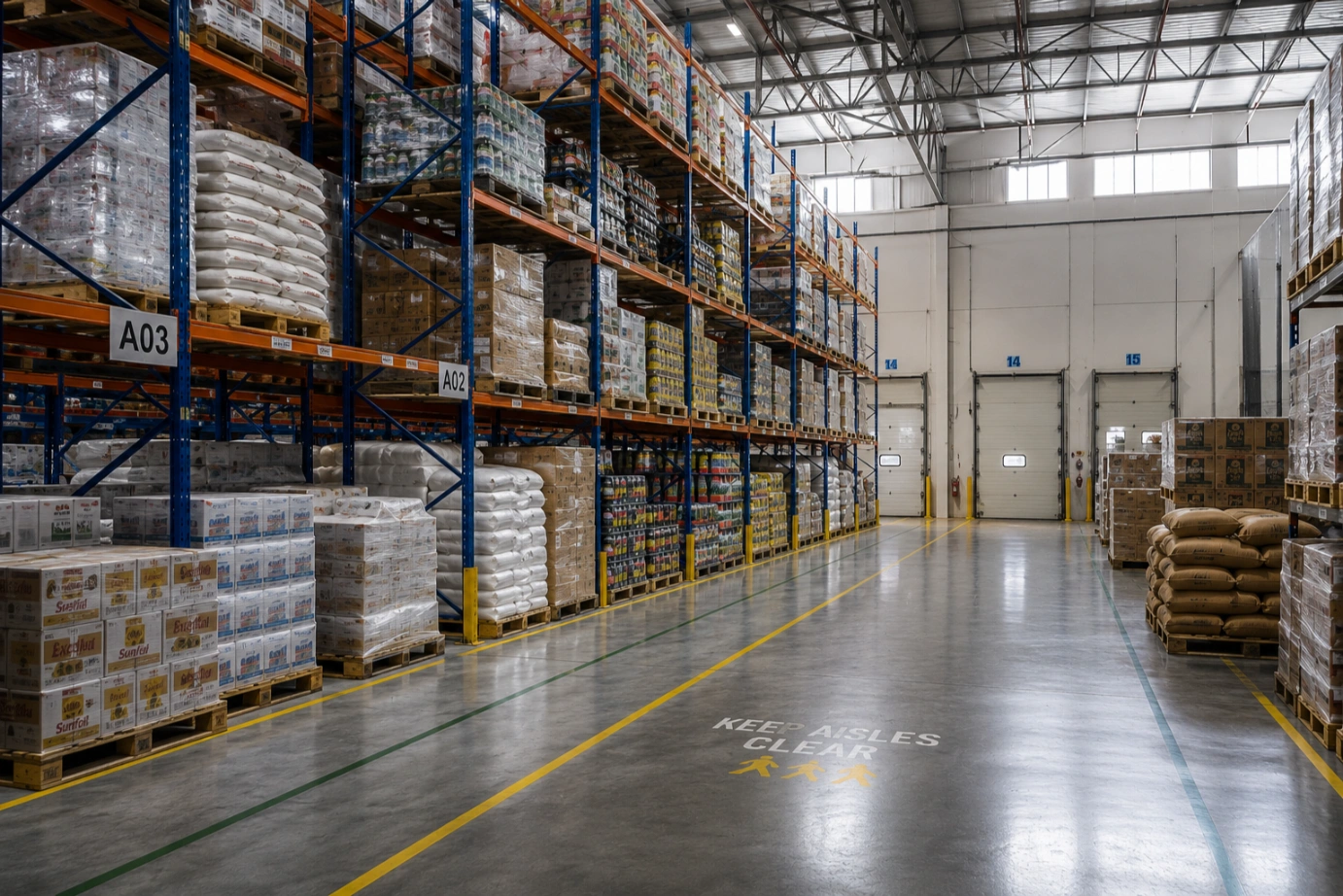
Good food-grade storage starts with the building itself. Floors, walls, and ceilings should be sound, smooth, cleanable, and free of flaking paint or cracked surfaces that harbour dirt. Doors, vents, and receiving bays should seal properly to keep pests, dust, and weather out. A live pest-control programme, with bait-station maps and monitoring records, should be visible rather than merely promised.
Temperature control and cold chain discipline
For chilled and frozen lines, temperature is the whole game. Expect calibrated monitoring, alarms for excursions, and a clear plan for what happens when a unit fails or power drops. Codex-aligned practice keeps most chilled food at or below five degrees, and a credible store can show logs proving it holds that line. Handover points, loading bays, and waiting times are where cold chain discipline is won or lost.
Stock rotation, segregation, and traceability
How stock moves matters as much as how it sits. First-expired-first-out rotation, clear date coding, and tidy separation of allergens, chemicals, and raw versus finished goods all signal a store that thinks ahead. Traceability should run both ways: any pallet should link back to a receipt and forward to a dispatch. If a batch cannot be traced in minutes, recall readiness is shaky.
Documentation buyers expect to see
Paperwork is where claims become proof. A buyer will typically ask for the Certificate of Acceptability, cleaning schedules, temperature records, pest-control reports, and goods-received and dispatch records. Calibration certificates for thermometers and a basic record of staff hygiene training round out the picture. A store that hands these over without fuss is usually a store that runs them daily.

The warehouse compliance checklist buyers and auditors run
The following warehouse compliance checklist captures the core items a buyer or auditor works through. It is deliberately practical, so an SME can self-assess before anyone else does.
- Legal: current Certificate of Acceptability, matched to the site and in date.
- Export, where relevant: PPECB cold store registration and current seasonal approval.
- Structure: sound, cleanable surfaces; sealed doors and bays; adequate lighting and ventilation.
- Pest control: active programme, station maps, monitoring records, and trend review.
- Temperature: calibrated monitoring, excursion alarms, backup-power plan, and retrievable logs.
- Hygiene: documented cleaning schedules, sign-off, and basic staff hygiene training records.
- Stock handling: clear rotation, date coding, and segregation of allergens, chemicals, and raw goods.
- Traceability: any batch traceable back to receipt and forward to dispatch within minutes.
- Records: goods-received notes, dispatch records, and deviation or corrective-action logs.
Treat each line as something to evidence, not just tick. A “yes” with no record behind it is really a “maybe”, and buyers read it that way too.
How to run storage audits without grinding operations to a halt
Compliance should not freeze the loading bay for a week. The trick is to run storage audits in tight, repeatable rounds. A short documentation review first confirms the legal basics and pulls recent logs, which can be done off-site or in an hour at a desk. Only then does a focused floor walk follow, checking the high-risk areas the records flag.
Frequency beats intensity. Quick weekly warehouse inspections by the on-site team catch drift early and keep the place audit-ready, so a buyer visit becomes confirmation rather than a scramble. Keep the same checklist order every time so results stay comparable month to month. When a gap appears, log it as a dated corrective action with an owner, because an open issue tracked is far less alarming to a buyer than a problem hidden.
A practical tip for SMEs using shared or third-party storage: vet the partner with the same rigour applied to ingredient suppliers. The supplier vetting checklist many SA buyers rely on maps neatly onto storage providers, and the food label compliance checklist helps confirm that what is stored matches what is declared. For producers weighing outsourced production and storage together, the co-packer selection checklist covers capacity and quality ownership in one pass.
Use Food and Beverage Trade South Africa to find compliant storage partners
Finding a storage partner that ticks these boxes is easier when the search starts with credible, trade-ready options rather than a cold online hunt. Browse the Food Trade Directory South Africa to shortlist warehousing, cold chain, and logistics providers, then run the warehouse compliance checklist against two or three candidates before committing. A clean comparison beats a rushed decision every time, especially when a listing window is closing.
Download the most relevant Food and Beverage Trade South Africa guide to dig deeper into supplier discovery and compliance. And if storage or logistics is the core business, registering for inclusion in an upcoming publication puts the right buyers a click away.
Conclusion
Food-grade warehousing is not glamorous, but it is where many good products quietly come undone. A warehouse compliance checklist turns vague reassurance into proof a buyer can act on, and it gives an SME a clear map of what to fix before anyone else points it out. Get the legal baseline right, hold the cold chain, keep the records tidy, and warehouse inspections stop being something to dread. In a market this tight, that kind of readiness is what keeps stock moving and buyers calling back.
FAQ
Do warehouses need a Certificate of Acceptability in South Africa?
Premises that handle or store food generally require a Certificate of Acceptability from the local authority under the R638 hygiene regulations. It confirms the site meets basic structural and hygiene standards. A storage partner should be able to produce a current certificate matched to the actual premises. Treat a missing or mismatched certificate as a serious risk.
What is the difference between storage audits and warehouse inspections?
Storage audits are deeper, scheduled, and document-led, often run against a standard or buyer specification. Warehouse inspections are quicker, more visual, and more frequent, including routine team walk-arounds. Audits confirm the system holds; inspections catch problems early. A strong operation uses both rather than choosing one.
When does a cold store need PPECB approval?
Cold stores handling perishable products destined for export must be registered with the PPECB and re-inspected each season. Approval can be revoked if the facility is not maintained. For domestic-only storage, R638 hygiene rules still apply even where PPECB does not. If export is on the roadmap, build PPECB approval into the plan early.
What records should a food warehouse keep?
At minimum: a current Certificate of Acceptability, cleaning schedules with sign-off, temperature logs, pest-control reports, and goods-received and dispatch records. Thermometer calibration certificates and staff hygiene training records strengthen the picture. Records should match what is physically on the floor. A store that produces these quickly is usually a well-run one.
How often should an SME run a warehouse compliance checklist?
Quick inspections weekly keep a site audit-ready and catch drift early. A deeper documented audit quarterly, or before a major buyer engagement, confirms the system still holds. Keeping the same checklist order each time makes results easy to compare. Consistency matters more than occasional intensity.
What temperature should chilled food be stored at?
Codex-aligned practice keeps most chilled food at or below five degrees Celsius, though specific products and buyer specs may set tighter limits. The key is calibrated monitoring and retrievable logs that prove the temperature held. A credible store also has a plan for power loss or equipment failure. Always confirm the exact requirement for the specific product and channel.