Introduction
It is early in the morning and a small-batch sauce producer is packing the day’s first cases for a courier run to a regional distributor. The labels look sharp, the jars are sealed, and the batch codes line up neatly. Then an email lands from a retail buyer asking for confirmation on the nutrition panel format, allergen declaration, net quantity expression, and date marking. Listing cannot proceed until the label is compliant, and the calendar suddenly feels very tight.
That moment is where a food label compliance checklist South Africa stops being “admin” and becomes a deal-saver. Retail listings in South Africa are unforgiving because the label is treated as a legal statement, a consumer information tool, and a buyer risk-control document all at once. A practical food label compliance checklist South Africa helps avoid reprints, rework, and delays when a category manager is ready to move.
This guide translates retail food labelling requirements South Africa into a repeatable workflow. It also covers nutrition panel requirements South Africa and the day-to-day realities of packaging compliance for FMCG South Africa, without turning the process into a monster. The goal is simple: make labels retail-ready, buyer-ready, and less stressful.
TL;DR: Key Takeaways
- Use a food label compliance checklist South Africa before every print run and before every retail listing submission.
- Confirm the pass-fail basics first: product name, ingredients, allergens, net quantity, date marking, business details, and batch identification.
- Treat nutrition panel requirements South Africa as a data and substantiation task, not only a design task.
- Align artwork, master data, and proof-pack documents so listing teams see consistent information across every SKU.
Why labels hold up retail listings in South Africa
Retail buyers do not only check whether a label looks professional. They check whether retail food labelling requirements South Africa are met, because a non-compliant label can trigger consumer complaints, withdrawals, and reputational damage.
That risk is pushed upstream to suppliers, which is why even “small” label gaps can block listing approval. Buyers read label issues as process issues, not one-off mistakes. Labels also cost real money, especially when print runs are small and changes are frequent.
When inflation and input costs are pressuring margins, avoidable reprints are the kind of expense that quietly sinks growth plans. This is why a food label compliance checklist South Africa belongs next to the production schedule, not buried in a desktop folder. A calm, consistent system beats a last-minute scramble every time.
The two sources buyers trust most
Buyer teams want suppliers to anchor decisions in official guidance, not hearsay. A practical starting point is the South African labelling and advertising regulations published via the Government Gazette, which set out presentation rules, prohibited statements, and specific provisions like date marking and batch identification.
Review the latest requirements using the official South African labelling and advertising regulations (Government Gazette). Procurement teams also appreciate credible local data when suppliers justify decisions about standardisation and cost control.
Stats SA CPI releases regularly show how food-related inflation moves, which is a useful reminder that avoidable label rework is not only compliance pain, it is cost pain too. Use the Stats SA Consumer Price Index release (July 2025) when building internal business cases for label governance and disciplined change control.

The food label compliance checklist South Africa workflow
A quick note before diving in: the phrase food label compliance checklist South Africa is repeated intentionally because it mirrors how buyers and SMEs search for practical help. The workflow below is designed to run at three moments: before design, before print, and before submission.
Run it consistently and the label review becomes routine instead of drama. That is exactly what retail listing teams want to see.
Step 1: Lock product facts before touching artwork
Start with a master product spec sheet and ensure every stakeholder is aligned on the facts. This avoids the classic problem where the ingredient deck changes after labels are printed and nobody updates the artwork.
Key facts include the recipe, additives, allergens, net content, storage conditions, and shelf-life assumptions. A food label compliance checklist South Africa is only as good as the product data feeding it. When suppliers scale from local sales into formal retail, a single “source of truth” becomes essential.
Keep the current recipe, supplier specs, and declarations together so that changes do not get lost in inboxes. For related operational context, starting a food business in South Africa shows how compliance and packaging decisions connect to route-to-market choices. That bigger picture helps keep label work focused and practical.
Step 2: Match product naming to retail systems
Retail systems use standard descriptions for listings, invoices, and shelf labels. If the label name conflicts with the product description on documents, listing teams often pause the process to avoid downstream confusion. Keep naming consistent across the unit label, the case label, and the product data sheet.
This is a small detail that creates big confidence. A food label compliance checklist South Africa should include a naming check that is easy to apply.
Say what the product is, not what it resembles, and avoid wording that could mislead. When descriptors are vague, buyers assume questions are coming later, and that slows decisions. Clear naming is a quiet signal that the supplier is organised.
Step 3: Ingredients list and allergen controls that survive scrutiny
An ingredients list must be accurate and ordered correctly, and it must remain accurate after supplier changes. This becomes tricky when compound ingredients are used, such as spice blends, flavour systems, or stabiliser mixes.
Build a supplier ingredient file so each compound ingredient has a breakdown ready for review. When a buyer asks, the answers should be immediate and consistent. Allergens must be handled with discipline across recipe, label, and factory controls.
If an allergen is present, it should appear in the ingredient list and in the allergen statement, aligned to the facility allergen matrix. A reliable food label compliance checklist South Africa checks the three-way match: recipe, supplier specification, and factory allergen risk assessment. When those align, retailer trust rises quickly.
Practical checks for ingredients and allergens
Confirm each additive declared matches supplier specifications and the current recipe. Confirm allergen declarations match the most recent formulation and supplier specs, not last season’s version.
Ensure precautionary allergen statements link to real cross-contact risk and controls, not blanket disclaimers. These checks directly support retail food labelling requirements South Africa and prevent “back to the drawing board” emails.
Step 4: Net quantity and packaging compliance for FMCG South Africa
Net quantity is not a design preference, and it is not optional. It is a compliance requirement that must match the actual packed quantity and the trade unit buyers will list. Retail buyers often reject labels that hide net quantity, use inconsistent expressions, or place it where it is hard to read.
That is why this step sits near the top of the food label compliance checklist South Africa. A strong food label compliance checklist South Africa includes net quantity placement rules, legibility checks, and a process to confirm declared net content matches verified pack weights.
When the food label compliance checklist South Africa is followed, net content errors become rare, and buyer questions reduce. This also supports packaging compliance for FMCG South Africa, because pack data flows into retail pricing, replenishment, and receiving. When quantities are clean, everything downstream runs smoother.
Step 5: Date marking and shelf-life clarity
Date marking is a high-sensitivity item for retail listing approval. Use clear, standard formats and ensure date marking on the unit and the case align for distribution reality.
If a product should be “best before” and the label uses “use by”, listing teams may request clarification or a reprint. That creates delays that feel unnecessary, because they are.
Shelf-life needs documented rationale, not guesswork, even if full shelf-life studies are still being built. Keep records of storage conditions, product characteristics, and any supporting testing that informs shelf-life decisions.
This documentation supports customer complaint handling and reduces disputes later. It also makes the food label compliance checklist South Africa easier to execute because the evidence is already organised.
Step 6: Batch identification and traceability readiness
Batch codes must enable recall action, not only internal tracking. Retailers want to see that a batch can be traced back to inputs, production records, and dispatch records.
This is a food safety expectation, but it is also a commercial trust expectation. When batch identification is weak, buyers assume other controls may also be weak.
A food label compliance checklist South Africa should specify how batch codes are generated, where they are printed, and who signs off each run. Keep batch code formats consistent across SKUs and channels to avoid confusion.
Ensure coding placement is practical for warehouse handling and retail receiving checks. When traceability is simple and reliable, buyers are more comfortable moving faster.
Step 7: Nutrition panel requirements South Africa without the guesswork
A nutrition panel is one of the most common sources of listing errors. The issue is often not the numbers themselves, but the format, rounding, serving size logic, and inconsistent units.
Treat nutrition panel requirements South Africa as a data management and governance task. When data is controlled, labels become stable.
Use verified lab results or credible calculation methods, keep source files, and ensure the label matches the underlying data exactly. If values change after reformulation, run a controlled update and do not allow packaging to lag behind formulation.
This is where a food label compliance checklist South Africa earns its keep, because it forces discipline. If the food label compliance checklist South Africa is signed off before print, nutrition disputes become far less common.
Common nutrition panel mistakes buyers flag
Missing required nutrients for the category or for the claims used is a common failure. Inconsistent serving sizes that make comparisons difficult also trigger questions from listing teams.
Values that look implausible for the product suggest calculation or transcription errors, which undermines trust. Nutrition values that do not support a claim stated elsewhere on pack can stop a listing immediately.
Step 8: Claims and marketing language red flags
Retailers are cautious with claims because claims create liability. If a label implies disease prevention or makes aggressive health promises, it is likely to be rejected.
Even softer “wellness” language can trigger scrutiny if it implies outcomes that cannot be supported. Buyers would rather avoid the risk than debate it.
A food label compliance checklist South Africa should include a claim audit as a standard step. Check whether claims are allowed, whether wording is acceptable, and whether evidence exists to support them.
If evidence is missing, remove the claim rather than defend it later. That approach protects relationships and keeps listings moving.
Step 9: Artwork controls that protect the budget
Many SMEs lose money by reprinting because artwork changes are not controlled. Use version numbers, approval dates, and a simple sign-off list that includes compliance review.
Keep a “gold master” PDF per SKU and control access to editable files. This reduces accidental changes and last-minute confusion.
Retailers read process control as supplier reliability. For insight into how buyers compare suppliers and why credibility signals matter, what a food and beverage directory is in South Africa provides helpful context.
When a supplier can show clean documentation and controlled artwork, the supplier becomes easier to shortlist. That is often the difference between “maybe” and “send the listing pack”.
Step 10: Pre-print proofing and pre-listing review
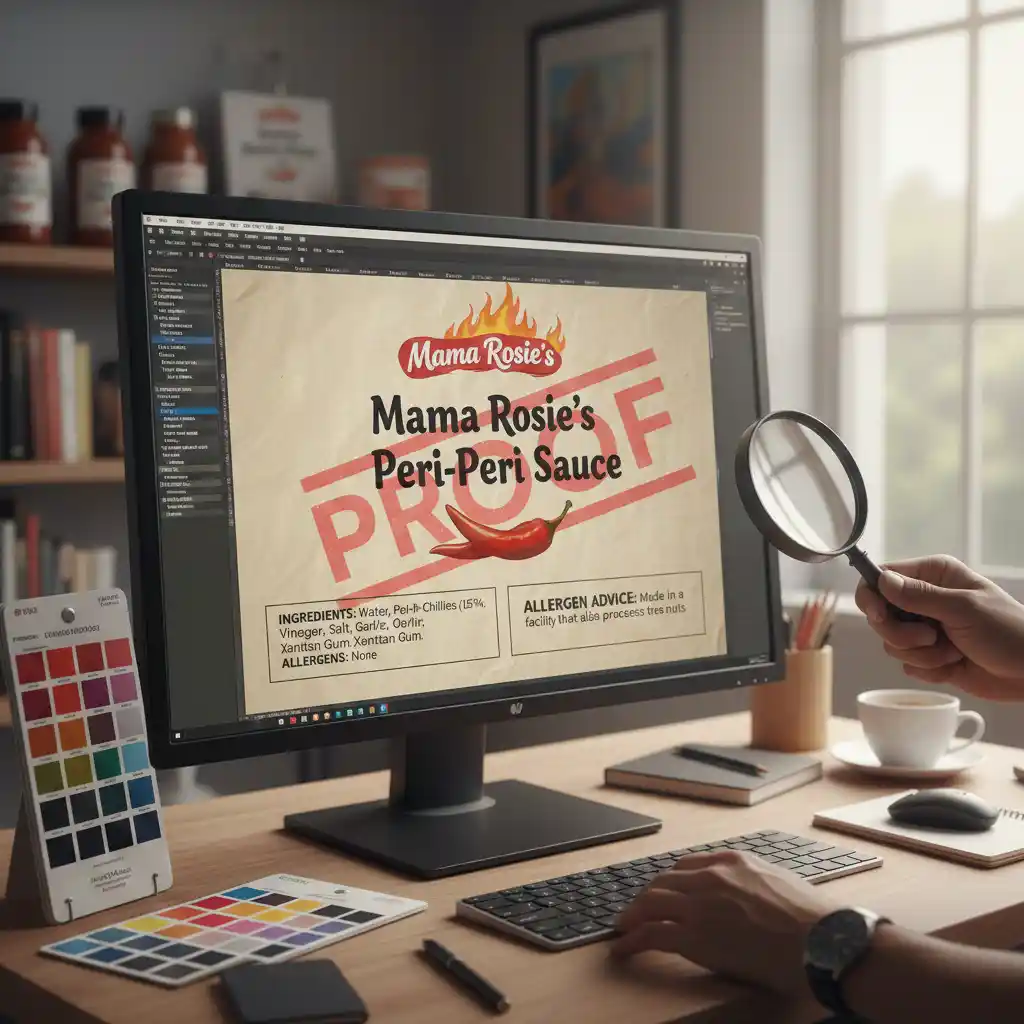
A pre-print proof is the last cheap moment to fix a problem. Use a structured review that includes compliance checks, operational checks, and commercial checks, and ensure the final artwork matches the master data.
Then run a pre-listing review where the label, spec sheet, and product images all match. Buyers notice mismatches immediately, and mismatches slow everything down.
For producers scaling into broader distribution, it helps to understand how label data flows through warehousing and retail receiving. The overview of the processed food supply chain in SA gives a practical operational view.
When label data matches case configuration and warehouse reality, distribution partners ask fewer questions. That is a quiet win that keeps momentum.
The retail submission pack that reduces back-and-forth
A label alone rarely closes the loop for retail onboarding. Listing teams often request supporting documents to validate what is stated on pack.
Build a submission pack that mirrors the label so the buyer sees alignment without needing follow-up emails. This is where many SMEs can speed up approvals significantly.
Core documents for faster listing approval
A practical food label checklist for retail listing approval South Africa typically includes, and it should be cross-checked against the food label compliance checklist South Africa used internally:
- Product spec sheet aligned to the label and invoice descriptions
- Ingredient and allergen declarations with supplier specs attached
- Nutrition evidence such as lab results or calculation outputs
- Shelf-life rationale and storage conditions
- Traceability and batch code explanation
- Product photos showing front, back, and the date or batch coding area
Once built, this pack reduces repeated requests across different retailers, wholesalers, and distributors. It also supports faster shortlisting, because buyers can assess risk faster and with more confidence.
For broad trade context and reference assets, Food and Beverage Trade South Africa trade guides is a useful starting point for how trade partners think about “buyer-ready” information. A well-organised pack is a strong commercial signal.
A simple label governance system for SMEs
Label governance does not need to be complicated, but it does need to exist. The goal is to assign responsibility, keep source documents, and create a routine review cycle.
When governance exists, the food label compliance checklist South Africa becomes a habit, not a crisis response. Over time, the food label compliance checklist South Africa becomes part of onboarding for new staff and service providers.
Roles and sign-offs
One person should own label master data and artwork versions so there is one clear “owner”. One person should sign off formulation and supplier updates so changes are controlled and traceable.
One person should sign off compliance review using the food label compliance checklist South Africa so accountability is clear. One person should sign off print proofs before purchase orders are placed so errors do not become expensive.
Review cycle that prevents surprises
Review labels every time a recipe changes, a supplier changes, or a new claim is added. Also review annually even if nothing changes, because buyer expectations and regulatory details can shift.
Put the review date into the production calendar so it is treated like any other critical control point. This single habit removes a lot of stress from retail food labelling requirements South Africa and keeps listings smoother.
Retail examples that commonly trigger rework
Most listing delays come from small issues that signal weak process control. The examples below map directly to the steps in a food label compliance checklist South Africa.
They also show why listing teams ask “basic” questions early. Fixing these issues upstream saves time and money.
Ingredient list mismatch after reformulation
A spice blend supplier changes carriers or anti-caking agents, and production uses the updated blend. The label still shows the old ingredient breakdown, because artwork was never updated.
A buyer audits the ingredient file, finds the mismatch, and blocks the listing until labels are corrected. The solution is tight change control and a checklist run after every formulation or supplier update.
Allergen statement conflicts with factory controls
A label uses a broad precautionary statement that is not supported by the allergen risk assessment. The buyer requests clarity because vague allergen statements reduce trust and can look like weak allergen management.
This is a common pain point for SMEs under retail food labelling requirements South Africa. Align the statement to actual risk and controls, and keep evidence ready.
Nutrition claim without evidence
A label uses a claim, but the nutrition panel does not support it. The buyer rejects the submission or requests updated evidence, which delays timelines.
This often happens when marketing copy is added late in design without a compliance check. A disciplined food label compliance checklist South Africa prevents this by forcing a claim audit before print.
Net quantity inconsistencies across pack formats
A single unit shows one net content value, but a multipack or case description implies a different total. Retail systems depend on accurate quantities for pricing, replenishment, and receiving checks.
Inconsistency creates downstream errors, so listing teams pause the process. Net quantity checks are a core part of packaging compliance for FMCG South Africa and should never be skipped.
Conclusion
If there is only one tool to keep close, it is the food label compliance checklist South Africa. Retail listing approval is often won or lost on the basics: clarity, accuracy, and repeatable process control.
When retail food labelling requirements South Africa and nutrition panel requirements South Africa are treated as part of a system, labels stop being a bottleneck and start acting like a trust signal. That is how SMEs move from “almost listed” to “on shelf”.
FAQ
What is the fastest way to use a food label compliance checklist South Africa?
Run it in three moments: before design, before print, and before retail submission. That timing catches issues when changes are still cheap. It also builds a repeatable habit that buyers interpret as supplier reliability.
Which labelling items most often block retail listing approval?
Allergens, net quantity expression, date marking, business details, and nutrition panel formatting are common blockers. Buyers also pause listings when product naming conflicts with invoice descriptions. These are the pass-fail items that should appear early in the checklist.
Do nutrition panel requirements South Africa require lab testing?
Not always, but credible evidence is needed. Many SMEs use validated calculations based on supplier ingredient data and confirm with periodic lab tests. Keep records so values and claims can be supported when a buyer asks.
How should allergen labelling be handled for shared facilities?
Use a formal allergen risk assessment and align the label statement to actual cross-contact risk and controls. Avoid blanket “may contain” statements that cannot be justified. Ensure ingredient declarations, allergen statements, and factory controls tell the same story.
What does packaging compliance for FMCG South Africa include beyond the label?
It includes net quantity accuracy, scannability where relevant, case labelling, and how packaging performs through storage and transport. Buyers also care about date and batch coding placement for receiving checks. Treat packaging and label data as one joined system.
How often should labels be reviewed?
Every time a recipe, supplier, pack size, or claim changes, plus an annual review. Add a reminder into the production calendar so it becomes routine. This reduces costly surprises and keeps listing timelines realistic.