Introduction
Delivery day starts long before the sun clears the vineyards. Pallets of glass-bottled sauces and marinades wait near the loading bay while a courier runs behind schedule. The labels are printed, the recipe is proven, and a retail buyer in Gauteng expects stock that tastes and looks exactly as it did during the tasting session months earlier. What happens to that stock between the factory door and the retailer’s shelf, though, was decided long before the truck arrived.
Getting food grade warehousing South Africa right is rarely treated as a strategic decision by smaller producers, yet it often determines whether a batch survives transport, humidity, and handling without losing quality. For a business built on family recipes and local ingredients, a warehouse choice made on price alone can undo months of production discipline in a single hot afternoon. The question that keeps coming up, for producers moving beyond home kitchens into retail and export channels, is a blunt one: cold storage or ambient warehousing? This article works through how to read a product category correctly, what South African regulation actually requires, and how to choose between cold storage and ambient warehousing without over-spending on refrigeration a shelf-stable product does not need.
Table of Contents:
TL;DR: Key Takeaways
- Perishable food categories face hard core-temperature rules under South African hygiene regulation, not just supplier preference.
- Shelf-stable sauces, marinades, and dry goods can usually be stored ambient, provided humidity, pests, and cross-contamination are controlled.
- Temperature monitoring records, not warehouse size, are usually what a retailer or inspector checks first.
- Grid reliability has improved sharply through 2026, but rising tariffs still change the cost case for refrigeration.
- A cold storage warehousing Johannesburg partner should be vetted on documentation and site visits, not sales promises.
What “food grade” actually means once stock leaves the factory
Food grade warehousing South Africa is governed by more than good intentions. The R638 hygiene regulations for food premises and the transport of food require a valid Certificate of Acceptability for any premises where food is handled, stored, or transported, and this extends to a vehicle used to move perishable food on a producer’s behalf. That single requirement quietly draws a line between a general dry-goods warehouse and one that actually qualifies as food grade. A facility without that certificate is not a food grade option, whatever its racking or refrigeration looks like on paper.
The line between general storage and food grade storage
A general warehouse might handle furniture one week and dry goods the next, with pallet racking and a roof that keeps the rain out. A food grade facility has to go further: washable, non-absorbent surfaces, documented pest control, no shared storage with agrochemicals or non-food goods, and cleaning schedules an inspector can request on demand. Ambient does not mean unregulated, and a warehouse storing shelf-stable sauces still needs to meet these baseline standards even without refrigeration.
Cold storage vs ambient warehousing: the core trade-off
The decision between cold storage and ambient warehousing usually comes down to what is actually inside the box, not what the brand story implies. A cream-based sauce, a fresh salsa, or anything containing dairy or raw protein behaves very differently in storage compared with a vinegar-based marinade or a dry spice blend. Getting this classification wrong in either direction is expensive: over-refrigerating shelf-stable stock wastes money every month, while under-refrigerating a perishable product risks spoilage, recalls, and a damaged relationship with a retail buyer.
When cold storage earns its keep
Under the same R638 regulations, chilled products such as raw fish, poultry, and dairy must be kept below 4 degrees Celsius, with most other perishable food required to stay below 5 degrees Celsius, and frozen products held between roughly minus 12 and minus 18 degrees Celsius depending on the category. These are not guidelines a warehouse can round up or down for convenience. Any product falling into these categories needs a facility built and monitored to hold those numbers consistently, including during loading, transit, and unloading, not only while sitting on a shelf.
When ambient warehousing is the smarter call
Shelf-stable marinades, vinegar-based sauces, dry rubs, and packaged goods that fall outside the regulatory definition of perishable food can generally be stored at ambient temperature, provided the facility itself is dry, pest-controlled, and free of extreme heat spikes. A product’s pH and moisture content matter more here than its label suggests, since a sauce with enough acidity or salt to inhibit microbial growth does not carry the same cold chain requirement as a fresh, unpreserved equivalent. Ambient storage is usually cheaper to run and easier to scale, which matters for a small producer watching margins closely.
Reading the product category correctly before choosing
Before signing a warehousing contract, it helps to run every SKU through a simple filter: is this product covered by the perishable food definition under South African hygiene regulation, and if not, does a retailer’s own specification demand cold storage anyway? Some national retailers set stricter internal cold chain rules than the regulatory minimum, particularly for products positioned in a chiller cabinet regardless of shelf stability. A warehouse compliance checklist is a practical starting point for working through these questions SKU by SKU, rather than guessing based on how a product is marketed.
The real cost picture: energy, tariffs, and grid reliability in 2026
The maths behind refrigeration has shifted meaningfully over the past year. Eskom recently confirmed that South Africa had passed more than four hundred consecutive days without load shedding, with over a million customers removed from load reduction schedules as generation performance improved through 2026. For a warehouse running compressors around the clock, that stability changes the risk conversation from backup generators and diesel spend to something more mundane: the actual electricity bill.
Tariff increases approved for Eskom’s direct and municipal customers through 2026 and into the next financial year mean that running a cold room is not getting cheaper even as reliability improves. This matters for the cold storage vs ambient warehousing decision because the cost gap between the two options is now driven more by power tariffs than by generator diesel or spoilage risk from outages. A producer weighing up a Johannesburg facility should ask a prospective partner for actual utility cost data, not a generic industry estimate pulled from an old brochure.
Temperature monitoring: the non-negotiable layer either way
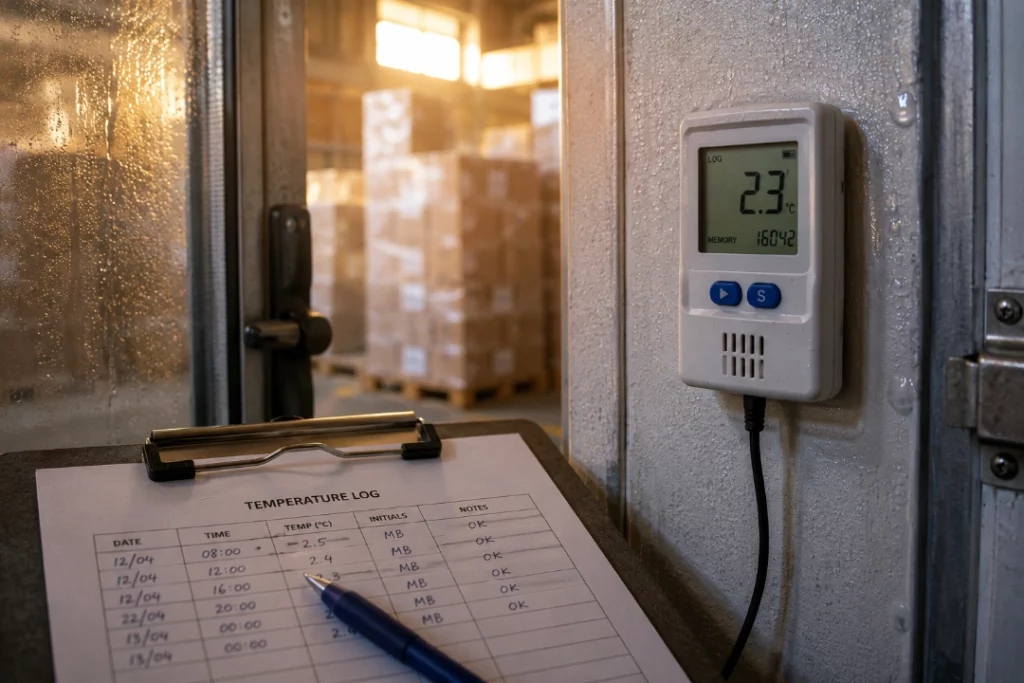
Regulation R638 requires that a chilling or freezer facility used for storing, displaying, or transporting perishable food carry a thermometer positioned so an accurate reading can be taken at any time, though the regulation allows temperature monitoring to be done according to what it calls the best available method. In practice, that opens the door to digital data loggers and remote sensors, which most modern facilities now use instead of a single wall-mounted dial. A buyer or inspector checking a facility is far more interested in a logged, time-stamped temperature history than in one reading taken during a site visit.
Ambient warehouses are not exempt from this discipline, even though the regulatory temperature bands do not apply in the same way. Heat spikes inside an uninsulated warehouse roof can still affect viscosity, colour, and shelf life in a bottled sauce, long before any safety threshold is crossed. Tracking temperature and humidity in an ambient facility, even informally with simple loggers, gives a producer an early warning before a batch quietly degrades on the shelf. The same discipline that keeps temperature logging consistent during transport should carry through into the warehouse itself, not stop at the loading bay door.
Where pick and pack services fit into the warehousing decision
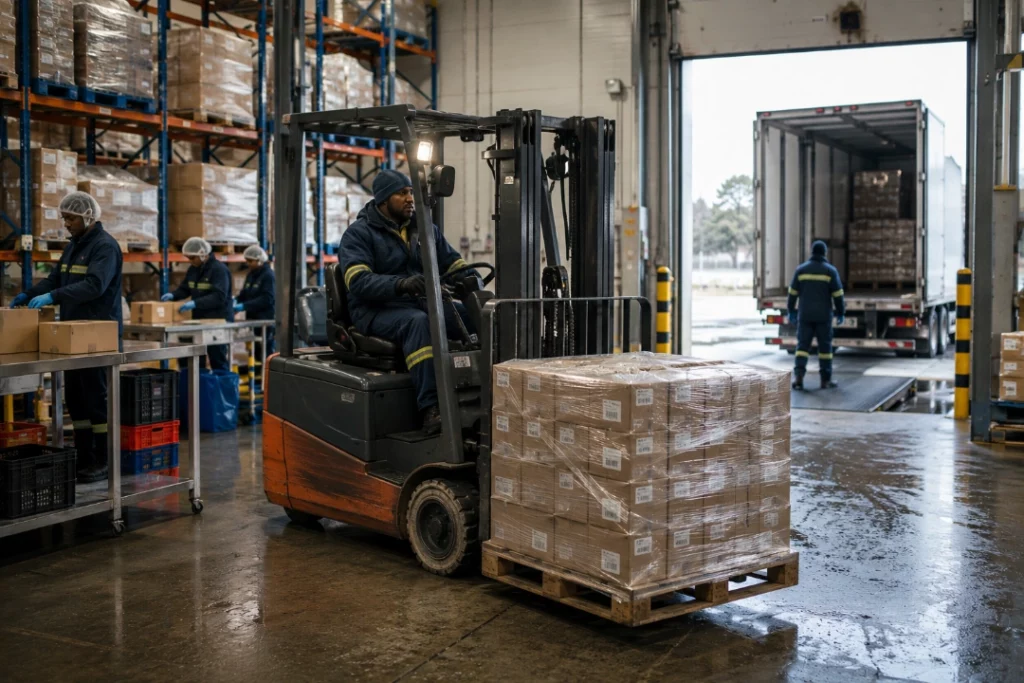
Many small and mid-sized producers do not actually need to own a warehouse. What they need is a partner who can store stock correctly and then prepare it for dispatch to a retailer’s exact specification, covering case configurations, labelling, and pallet building. This is where pick and pack services become part of the warehousing conversation rather than a separate logistics question. A facility that stores product correctly but then moves it into an unregulated ambient area for packing before dispatch can quietly undo the value of the cold storage paid for earlier in the chain.
Producers should ask a prospective warehouse directly whether pick and pack services happen inside the same temperature-controlled zone as storage, or in a separate area with its own risks. This detail rarely appears in a sales brochure but matters enormously for chilled or frozen product lines heading straight to a retail distribution centre. A short, honest answer here says more about a provider’s operational maturity than any marketing material ever will.
A simple framework for how to choose between cold storage and ambient warehousing
A structured decision, rather than a gut call, tends to hold up better once volumes grow. The following sequence works for most small and mid-sized food and beverage producers weighing up how to choose between cold storage and ambient warehousing:
- Classify every SKU against the perishable food definition in South African hygiene regulation, not against how the product is marketed.
- Check whether any retail buyer has a stricter internal cold chain specification than the regulatory minimum.
- Model the running cost of refrigeration at realistic pallet volumes, using actual tariff data rather than estimates.
- Confirm whether pick and pack services happen inside the correct temperature zone, not in a separate ambient area.
- Consider a hybrid facility with both zones if the product range spans perishable and shelf-stable categories.
Vetting a cold storage warehousing Johannesburg partner before signing
Johannesburg sits at the centre of South Africa’s inland distribution network, which makes it a natural hub for producers serving Gauteng retailers and onward logistics to other provinces. A cold storage warehousing Johannesburg search returns plenty of options, but proof matters more than proximity to a highway interchange. Ask directly for a current Certificate of Acceptability, recent pest control reports, and a sample of temperature monitoring logs before any contract is discussed.
A short site visit, even an informal one, tends to reveal more than a polished sales deck. Checking whether chilled and ambient stock are physically separated, whether staff can explain their own cleaning schedule without checking notes, and whether the facility can produce documentation on request are simple but effective filters. For producers who are not yet ready to commit to a single warehousing partner, the fresh food service providers directory is a reasonable starting point for comparing cold storage and transport specialists across the country.
Conclusion
Warehousing is not a line item to settle once and forget. The right answer for one product line in a range might be ambient, while the sauce sitting next to it on the same production run genuinely needs cold storage and the temperature discipline that comes with it. Getting food grade warehousing South Africa right means classifying products honestly, respecting the regulatory floor, and choosing a partner who can prove compliance rather than simply claim it. None of this needs to be complicated, but it does need to be deliberate.
For producers ready to compare options more broadly, downloading a guide or registering a business with Food and Beverage Trade South Africa is a practical next step before any warehousing contract gets signed. Either action turns a general online search into a shortlist built on documented capability rather than guesswork. Producers weighing up a first cold storage contract are better served by comparing two or three vetted options than by signing with the first warehouse that answers the phone.
FAQ
What is food grade warehousing South Africa in practical terms?
It refers to storage space that meets the hygiene, cleaning, pest control, and temperature standards required under South African food safety regulation, rather than a general dry-goods warehouse repurposed for food products. A valid Certificate of Acceptability is usually the clearest proof that a facility qualifies.
Is ambient warehousing safe for sauces and marinades?
Many shelf-stable, preserved, or low pH sauces and marinades can be stored safely at ambient temperature, provided the warehouse itself is dry, pest-controlled, and free of extreme heat. Producers should still confirm this against the product’s actual formulation rather than assuming based on the category alone.
What temperature must chilled food be stored at under South African law?
Regulation R638 sets core temperature limits of below 4 degrees Celsius for raw fish, poultry, and dairy, and below 5 degrees Celsius for most other perishable food, with frozen categories held between roughly minus 12 and minus 18 degrees Celsius.
Do small producers need to own a cold storage facility?
Most small and mid-sized producers are better served by outsourcing to an established cold storage or ambient warehousing partner than by building their own facility. Ownership only tends to make sense once volumes justify the capital and compliance overhead involved.
How does grid reliability affect the cold storage decision in 2026?
South Africa has recorded an extended run without load shedding through 2026, which has reduced the outage risk that once made backup generators essential for cold storage. Rising electricity tariffs have replaced outages as the main cost consideration for anyone running refrigeration at scale.
What should a buyer look for in a cold storage warehousing Johannesburg partner?
A current Certificate of Acceptability, recent pest control reports, temperature monitoring logs, and a willingness to accommodate a site visit are the basics worth confirming before signing anything. Proximity to distribution routes matters less than documented compliance.
How often should temperature monitoring records be checked?
Records should be reviewed regularly enough to catch a drift before it becomes a spoiled batch, which in practice means daily or continuous digital logging rather than periodic manual checks. Retail buyers increasingly ask to see this history as part of their own supplier vetting process.