Introduction
It is still dark in the Stellenbosch winelands when the first delivery bakkie pulls out of a small production yard, loaded with bottled sauces and marinades bound for a regional distributor. A week earlier, that same distributor sent through a buyer questionnaire asking for proof of pesticide residue testing on key ingredients, along with a current microbiological testing certificate for the finished product. For a small producer built on family recipes and locally sourced ingredients, that kind of email can feel like a speed bump on the road to a bigger order. The instinct is to test everything on every batch just to be safe, but that instinct is expensive, and it is often unnecessary.
Getting residue and quality testing right is less about buying more lab time and more about knowing which test answers which question. A pesticide residue testing result tells a buyer that chemical inputs on raw ingredients sit within legal and commercial limits. A microbiological testing result tells the same buyer that the product will not make anyone sick before its stated date. Confusing the two, or running both blindly on every SKU, drains cash that a small business genuinely needs elsewhere.
Table of Contents:
TL;DR: Key Takeaways
- Pesticide residue testing and microbiological testing answer different risk questions and rarely need to run on every single batch.
- South African pesticide residue limits sit under two pieces of legislation, and export buyers frequently expect proof that goes beyond the local minimum.
- Shelf life studies convert lab data into a defensible date on the label, rather than a guess copied from a similar product.
- A risk-based testing plan, built around ingredients, process steps, and sales channel, protects a business without draining its budget.
- Export buyers of fresh produce ask for a fairly consistent testing package, and understanding it is useful even for processed food businesses eyeing export later.
Why testing decisions carry real financial weight for small SA producers
A single round of pesticide residue testing or microbiological testing at an accredited South African lab is not a small line item for a business running on tight margins. Multiply that cost across every ingredient batch, every finished product variant, and every retailer or export enquiry, and testing can quietly become one of the largest recurring expenses in the business. That pressure is exactly why so many SME owners either over-test out of anxiety or under-test out of necessity, and both choices carry real consequences.
The cost of testing everything, and the cost of testing nothing
Testing every batch of every product against every possible contaminant sounds thorough, but it rarely reflects actual risk. A shelf-stable, high-acid sauce carries a very different microbiological risk profile from a refrigerated, low-acid marinade, yet both are sometimes tested identically out of caution rather than judgement. On the other end, skipping pesticide residue testing entirely on herb or spice inputs because “the supplier said it was fine” leaves a business with no proof to hand over the day a retailer or export buyer asks for it, and that gap can stall a listing indefinitely.
Pesticide residue testing: what South African rules actually require
South African export legislation requires that only agricultural remedies registered for a specific crop are used, that products do not exceed the residue limits of the importing country, and that producers keep records of every chemical remedy applied, whether as a spray programme or a post-harvest treatment. That obligation does not disappear once a raw ingredient, such as a herb, spice, or fruit component, is bought in for further processing. A sauce or marinade business sourcing from smallholder or contract growers still carries responsibility for what ends up in the finished product.
MRLs sit under two pieces of legislation, not one
Maximum residue limits in South Africa are not governed by a single, simple rulebook. Agricultural remedy registration and permitted use sit under the Fertilizers, Farm Feeds, Agricultural Remedies and Stock Remedies Act (Act No. 36 of 1947), administered by the Department of Agriculture, Land Reform and Rural Development, while the maximum permitted levels of those residues in finished foodstuffs fall under the Foodstuffs, Cosmetics and Disinfectants Act. Knowing which authority governs which part of the chain matters when a producer is deciding what to ask a supplier for, and what a lab report actually needs to demonstrate.
Export buyers expect more than the domestic minimum
Meeting the domestic maximum residue limit is the floor, not the ceiling, for any business with export ambitions. South African producers and exporters are expected to verify the specific MRLs of the destination market with their importer or agent, since a chemical remedy that is perfectly legal for local sale can still exceed the tolerance set by a European or Middle Eastern buyer. This is one reason a compliance checklist for starting a food business in South Africa is worth revisiting even for an established producer, since export readiness often means retracing steps that were only set up for the local market.
Microbiological testing: where it earns its keep
Microbiological testing exists to answer a narrower but higher-stakes question than pesticide residue testing: will this product remain safe to eat for the length of time promised on the label, under the storage conditions actually used to move and sell it. That question matters most for chilled, low-acid, or moisture-rich products, where organisms such as Listeria monocytogenes or Salmonella species can establish themselves if a process step or cold chain link fails. A high-acid, shelf-stable sauce with a validated pH and processing method carries a materially lower microbiological risk than a fresh, chilled marinade sitting in a retail fridge for two weeks.
High-risk categories that should never skip it
Ready-to-eat, chilled, and low-acid products sit at the top of the priority list for regular microbiological testing, along with anything targeting infant, elderly, or immunocompromised consumers. South Africa’s Perishable Products Export Control Board operates a SANAS-accredited, ISO/IEC 17025 laboratory that performs pesticide residue MRL testing, mycotoxin analysis, fats analysis, and compositional testing across a wide range of matrices, serving both export and domestic markets. Using an accredited lab for this category is not a nice-to-have; it is the baseline most retail and export buyers already assume is in place.
Shelf life studies: turning lab results into a date buyers trust
A best-before or use-by date is a commercial promise, and shelf life studies are what turn that promise into something defensible rather than a number copied from a similar product on a competitor’s shelf. A proper study combines microbiological testing at defined intervals with sensory and, where relevant, chemical checks, run under storage conditions that match how the product will actually be handled, not an idealised lab environment. Skipping this step and simply guessing a date is one of the fastest ways to end up with a recall, a retailer complaint, or a quiet loss of trust that never gets explained.
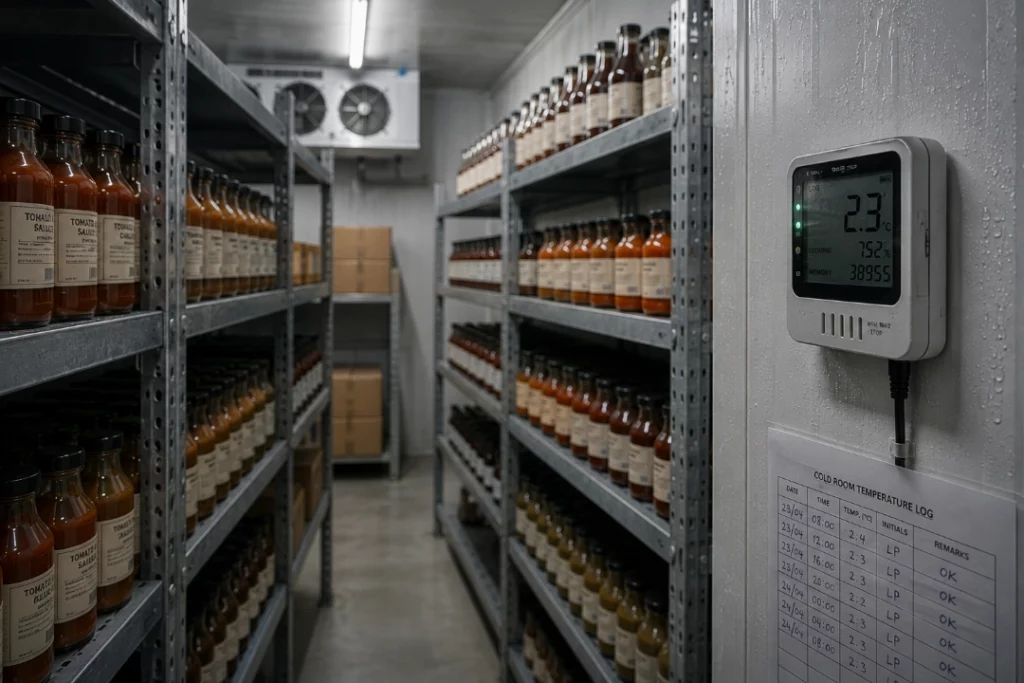
Storage conditions are inseparable from shelf life claims, which is why a warehouse compliance checklist for cold storage and traceability belongs in the same conversation as lab testing. A shelf life study run at a controlled 4°C means little if the actual distribution chain regularly sits closer to 8°C during a delivery run, particularly during load-shedding-affected months when refrigeration units are cycling on backup power. Matching the study conditions to real operating conditions is what makes the label date genuinely trustworthy.
What tests do export buyers require for fresh produce
Fresh produce exporters face a more codified set of expectations than most processed food SMEs, and it is worth understanding even for a business not yet exporting, because retail buyers increasingly borrow the same standards. Export consignments typically require pesticide residue testing aligned to the destination market’s limits, phytosanitary certification confirming freedom from regulated pests, and cold chain records demonstrating the product was held at the correct temperature from packhouse to port. Fresh fruit and vegetables inspected for export in South Africa are also subject to quality and phytosanitary checks performed by assignees operating under the Agricultural Product Standards Act, alongside the residue and food safety testing already covered under export legislation.
For a processed food business, the practical takeaway is that buyers moving into retail or export channels increasingly expect the same discipline: a named, accredited lab, a documented sampling frequency, and paperwork that matches what is actually on the shelf. Food label compliance and testing evidence tend to travel together in a buyer’s mind, since a food labelling requirements guide for South African producers covers exactly the kind of date-marking and claims-support questions that a lab report is meant to back up.
Building a testing plan without over-testing
A workable testing plan starts with risk, not with a generic checklist copied from another business. That means mapping every ingredient and process step to a specific question: does this input carry a known pesticide risk, does this process step introduce a microbiological hazard, and does this claim on the label need to be backed by a specific test result. Once those questions are answered honestly, the testing calendar tends to shrink rather than grow, because most of what gets tested “just in case” turns out to be low risk once it is actually assessed.
A simple risk-based framework
Start by grouping products into risk tiers based on pH, water activity, storage temperature, and target consumer, then set a testing frequency per tier rather than per product. High-acid, shelf-stable items might only need microbiological testing on new formulations or after a significant process change, while chilled, low-acid products justify routine batch testing. Pesticide residue testing on raw ingredients can often be scheduled seasonally or per new supplier, rather than per batch, provided supplier declarations and spray records are collected consistently in between.
Briefing an accredited lab properly
A lab can only test for what it is told to look for, so a vague brief tends to produce either an incomplete result or an inflated invoice covering tests that were never needed. A useful brief states the product category, the specific claims being made on the label, the intended shelf life, the storage and distribution conditions, and the channel (local retail, foodservice, or export) the product is heading into. Producers who research and register in a structured food trade directory and supplier hub often find it easier to compare notes with other SMEs on realistic testing frequencies for similar product categories.
Common mistakes that quietly inflate testing budgets
The most expensive mistake is treating pesticide residue testing and microbiological testing as interchangeable insurance policies rather than answers to specific questions. A close second is re-testing an unchanged formulation every quarter out of habit, when a shelf life study already validated the product for its full intended life. A third is accepting a supplier’s verbal assurance on chemical inputs without ever asking for a spray record or a certificate of analysis, which leaves nothing to show a buyer, an auditor, or an inspector the day it is requested.
Conclusion
Residue and quality testing does not need to be an all-or-nothing exercise for a South African food or beverage SME. Pesticide residue testing answers a chemical-input question, microbiological testing answers a safety-over-time question, and shelf life studies tie both back to a date that can actually be defended. Building a plan around real risk, rather than blanket caution, keeps a producer buyer-ready without turning the lab bill into the biggest expense on the books.
FAQ
What is the difference between pesticide residue testing and microbiological testing?
Pesticide residue testing measures chemical inputs left on raw ingredients or finished products, checked against legal and buyer-specific limits. Microbiological testing checks for spoilage organisms and pathogens that affect food safety over the product’s stated shelf life. Both matter, but they address different risks and rarely need to run at the same frequency.
Does every batch need pesticide residue testing?
Not necessarily. Frequency should be based on the risk profile of the specific ingredient, the consistency of the supplier, and whether the product is destined for export, where destination-market limits may be stricter than domestic ones.
How often should microbiological testing be repeated on an unchanged product?
If the formulation, process, and packaging have not changed and a shelf life study already validated the product, routine re-testing every batch is usually unnecessary. Testing is best triggered by a formulation change, a new supplier, a process shift, or a buyer or audit requirement.
What tests do export buyers require for fresh produce?
Export buyers typically expect pesticide residue testing aligned to the destination country’s maximum residue limits, phytosanitary certification, and documented cold chain records from packhouse through to port, in addition to the quality and food safety inspections already required under South African export legislation.
Where can an SME get accredited lab testing food South Africa can rely on for buyer conversations?
Look for a laboratory accredited by SANAS to the ISO/IEC 17025 standard, since this accreditation is the benchmark most South African retailers, exporters, and auditors recognise as credible.
Do shelf life studies replace the need for microbiological testing?
No, a shelf life study relies on microbiological testing, along with sensory and, where relevant, chemical checks, conducted at set intervals under realistic storage conditions. The study is the process; the testing is one of its core components.
Is pesticide residue testing only relevant to fresh produce businesses?
No, any processed food business using herbs, spices, fruit, or vegetable inputs carries some exposure to pesticide residue, which is why supplier records and periodic testing remain relevant even for a bottled sauce or marinade producer.