Introduction
The email lands just before the mid-morning rush: a national buyer wants a live trace on one batch, from ingredient lot to dispatch customer, by end of day. For a small producer, that single request reveals more than any sales pitch ever could. It shows whether food traceability standards are built into the daily routine or filed away in a dusty binder. This guide unpacks the food traceability standards South Africa retailers and export buyers typically treat as the minimum, so a business knows exactly what to have ready before the question arrives.
Table of Contents:
TL;DR: Key Takeaways
- R638 of 2018 makes a traceability system and a recall procedure a legal minimum for all SA food premises, not a nice-to-have.
- Retail buyers expect clear batch coding, one-up one-down records, and proof that recall procedures have been tested.
- Export buyers add PPECB certification, residue testing, and faster trace expectations on top of the domestic baseline.
- Simple, disciplined traceability systems South Africa SMEs can run on spreadsheets will pass most vetting checks if records are consistent.
Why traceability is the quiet dealbreaker in SA trade conversations
Buyers seldom open a meeting with traceability, yet it quietly decides who makes the shortlist. A retailer carries the reputational risk for every product on its shelves, so it cannot afford a supplier who needs three days to find a batch. When something goes wrong, the cost of a slow trace is measured in write-offs, chargebacks, and lost listings. That is why food traceability standards sit near the top of nearly every serious vetting conversation, even when nobody calls them by name.
The regulatory floor: what R638 actually requires
South Africa’s legal baseline is set by R638 of 2018, the general hygiene regulations published under the Foodstuffs, Cosmetics and Disinfectants Act. Regulation 10 places the duty on the person in charge of a food premises to maintain a traceability system according to the best available method, keep a recall procedure in place, and report any recall activation to the local inspector and the National Directorate: Food Control. The same regulation requires records covering processing, production, and distribution to be retained for at least six months after the product’s shelf life has ended. The full text is available through the official R638 hygiene regulations, and it applies to every food premises in the country, from a two-person kitchen to a national factory.
What “minimum” means to a retail buyer
A buyer’s minimum is always a step above the legal minimum, because the buyer is protecting a category plan, not just compliance. Where the law says “best available method”, a retailer reads “show me it works under pressure”. That gap between legal compliance and commercial expectation is where many promising suppliers stall. Understanding both layers is what separates a supplier who is merely registered from one who is genuinely trade-ready, which is exactly the standard applied in a structured supplier vetting checklist for SA buyers.
The retail minimum: what SA buyers typically expect before listing
Most South African retail and foodservice buyers converge on the same short list of traceability expectations. None of them require expensive software, but all of them require discipline. Together they form the practical floor of food traceability standards in the local market. A supplier who can demonstrate all three moves through vetting noticeably faster.
Batch coding that survives the factory floor
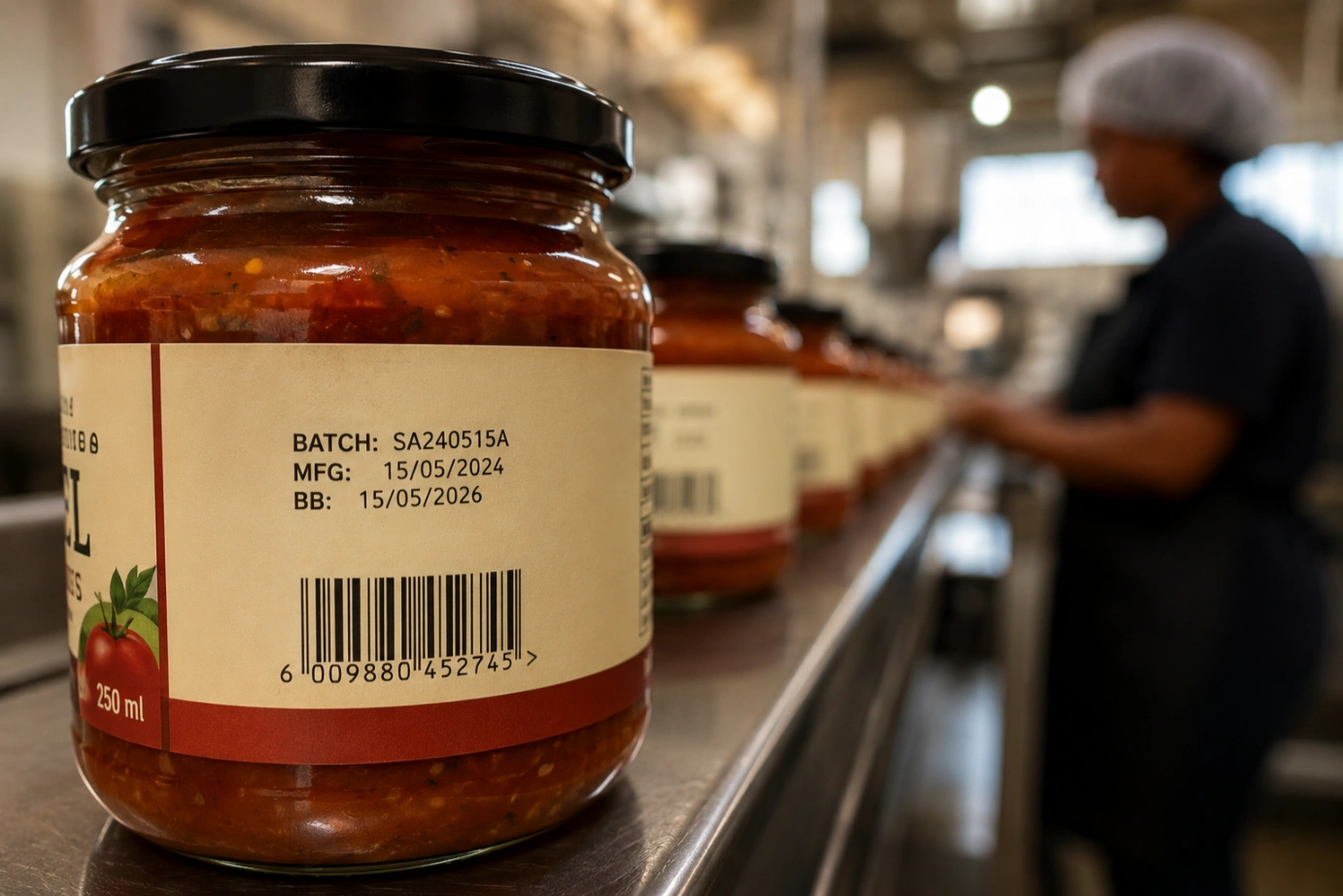
Batch coding is the backbone of any traceability claim. R638 requires that a container of foodstuff be clearly marked with a batch number so the specific batch is easily identifiable and traceable. Buyers take this further: the code must be legible after transport, consistent between the label, the production record, and the dispatch note, and applied to every unit, not just the outer carton. A smudged inkjet code or a label that does not match the batch register reads as risk, no matter how good the product tastes.
What a usable batch code looks like
A workable format links the production date, the line or shift, and a sequential lot reference. The exact structure matters less than consistency, because a buyer will test whether the same code appears in the same form across all records. Codes should also align with date marking on the pack so a trace does not require guesswork. Keep it boring and repeatable, and it will hold up in any audit.
One-up, one-down records, kept long enough to matter
The accepted commercial minimum is one step back and one step forward. That means every incoming ingredient lot is recorded against a supplier and delivery date, every production batch is linked to the ingredient lots it consumed, and every dispatch is linked to the customers who received that batch. Buyers do not expect a small producer to trace a spice back to the farm, but they do expect the chain to be unbroken within the business. Records must also meet the R638 retention rule of at least six months beyond shelf life, which for long-life products can mean keeping paperwork for years.
Recall procedures that have been tested, not just written
A recall plan that has never been rehearsed is a theory, not a procedure. Buyers listen for named roles, clear triggers, current contact lists, and evidence of at least one mock recall with lessons recorded. Recall procedures also connect directly to labelling accuracy, because an undeclared allergen is one of the most common recall triggers in any market. Getting label content right the first time, using a practical food label compliance checklist, removes one of the biggest recall risks before it ever reaches a shelf.
What export buyers add on top of the domestic minimum
Export buyers start from the same baseline and then raise the bar. International retailers and importers often face their own regulators, so they pass those requirements down the chain. For perishable products, much of this is formalised through South Africa’s official export control system rather than left to negotiation. A boer maak ‘n plan, but in export trade the plan must come with certificates attached.
PPECB certification and the export paper trail
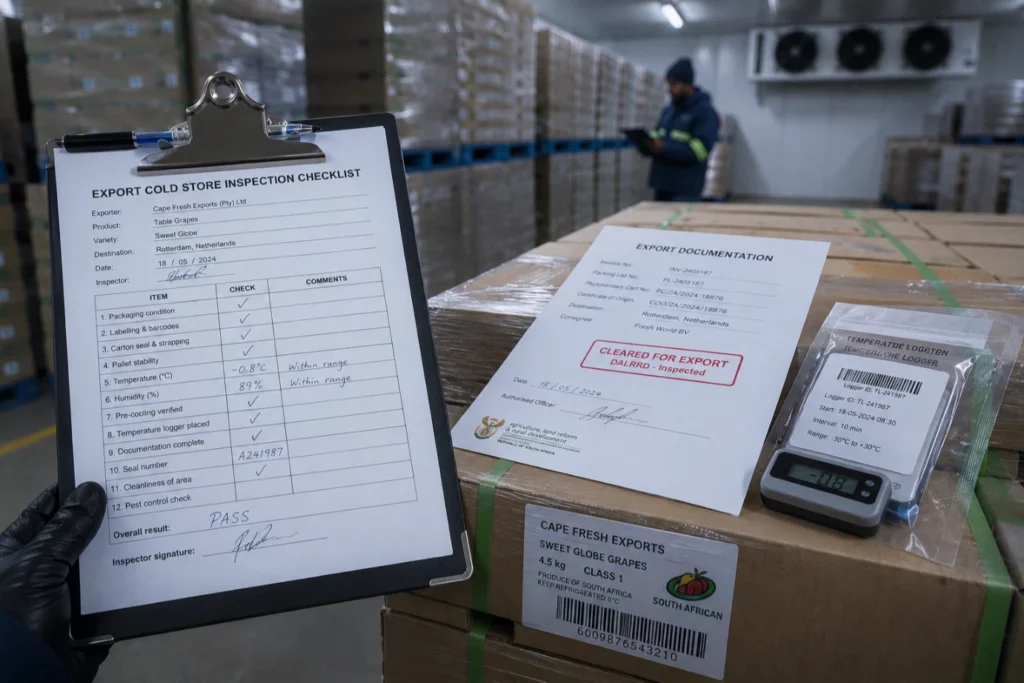
For perishable products of plant origin, the Perishable Products Export Control Board is the official certification agency, mandated under the PPEC Act of 1983 and the Agricultural Product Standards Act. Its product inspection services cover end-point inspection, cold chain management, and food safety audits on food business operators exporting perishable produce. Products approved for export carry the passed for export stamp, which importers treat as assurance that minimum export standards were met. For an exporter, PPECB registration, inspection records, and laboratory verification become part of the traceability file a buyer expects to see.
Mock recalls and the four-hour trace expectation
Many export buyers and certification schemes expect a full trace exercise to be completed within hours, not days. A common benchmark in audits is reconciling an entire batch, ingredients in and product out, within roughly four hours. Export documentation adds further layers, since each consignment links batch records to inspection certificates, container numbers, and temperature data. Suppliers preparing for this level should also confirm their pack formats against current rules on the labelling requirements for South African food, because destination-market labels still need to reconcile with local batch records.
Building traceability systems South Africa SMEs can actually afford
The good news is that traceability systems South Africa producers need at the entry level are more about habit than hardware. Buyers consistently reward reliability over sophistication. A controlled spreadsheet that is filled in every single production day beats an expensive system that staff bypass when things get busy. The standard is simple: any batch, any day, traceable in one sitting.
Spreadsheets versus software: discipline beats complexity
Software earns its keep once volumes, SKUs, or customer counts make manual records fragile. Until then, a locked master register, daily batch sheets, and a single source of truth for lot numbers will satisfy most vetting checks. The failure mode is never the tool, it is inconsistency: codes recorded in one format on Monday and another on Thursday. Whatever the system, back it up, restrict who edits it, and review it weekly so gaps are caught now-now rather than during a buyer’s trace test.
A minimum viable setup for a small producer
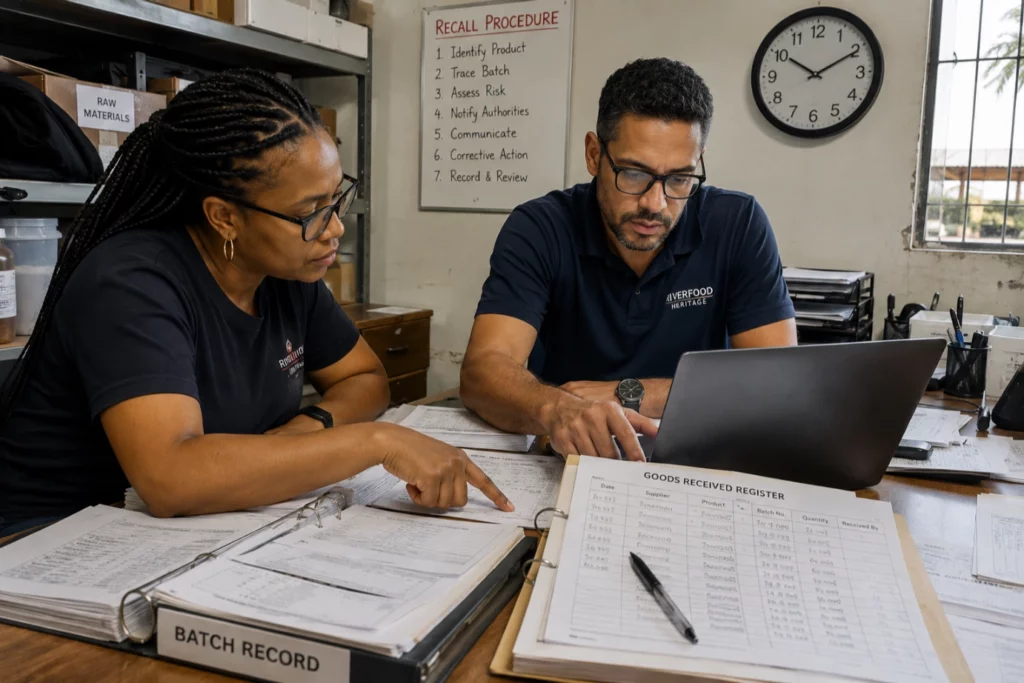
Start with three linked records: a goods received register, a production batch sheet, and a dispatch log. Each record carries the batch code as the connecting thread, with dates, quantities, and responsible names. Add a one-page recall procedure with current contact details and run a mock recall twice a year. That modest setup already meets the spirit of R638 and the expectations of most domestic buyers.
How buyers test a traceability claim during vetting
Expect a buyer to pick a batch code from a recent delivery and ask for the full story behind it. A strong supplier produces the ingredient lots, the production record, the quality release, and the customer list for that batch without drama. A weak supplier asks for more time, and the silence does the talking. Some buyers also run the test in reverse, starting from an ingredient lot and asking which finished batches contain it, which is exactly how an allergen or contamination recall would unfold in real life.
Where Food and Beverage Trade South Africa fits in
Traceability proof is most valuable when the right buyers can actually find the business behind it. Suppliers who have their batch coding, records, and recall procedures in order can make that readiness visible by being listed where procurement teams already search, starting with the Food Trade Directory South Africa hub. Download the trade guide most relevant to your sector to see what buyers expect across compliance, logistics, and route to market. If the business is ready to be discovered, register it to be featured in an upcoming publication and put that trade-readiness in front of the buyers who need it.
Conclusion
Food traceability standards in South Africa rest on a clear legal floor and a slightly higher commercial bar. R638 makes a traceability system, batch marking, and recall procedures mandatory, while retailers and export buyers add tested proof, consistent records, and certification on top. The encouraging part is that meeting the food traceability standards South Africa buyers apply does not demand expensive technology, only unbroken discipline from goods received to dispatch. Build the habit now, and the next trace request becomes a chance to impress rather than a scramble to survive.
FAQ
What are the minimum food traceability standards in South Africa?
R638 of 2018 sets the legal floor: a traceability system maintained by the best available method, a recall procedure, batch numbers on containers, and records kept for at least six months after shelf life ends. Buyers typically add one-up one-down record keeping and proof of a tested recall plan. Together these form the practical minimum for trade.
Is batch coding legally required for SA food products?
Yes, R638 requires containers of foodstuffs to be clearly marked with a batch number so the batch is easily identifiable and traceable. Labelling regulations also define a batch as a product made under the same conditions within 24 hours. Buyers expect the code on the pack to match production and dispatch records exactly.
How long must traceability records be kept?
R638 requires records applicable to processing, production, and distribution to be retained for at least six months after the shelf life of the product has ended. For long-life ambient products this can mean several years of records. Digital backups make this far easier to manage.
Do small producers need traceability software?
Not at entry level. Controlled spreadsheets with a goods received register, batch sheets, and a dispatch log will satisfy most buyers if they are consistent and complete. Software becomes worthwhile as SKUs, volumes, and customer numbers grow.
What extra traceability proof do export buyers expect?
For perishable products, PPECB registration, inspections, and export certification become part of the file, alongside laboratory residue testing where applicable. Many export buyers and audit schemes also expect a full mock trace completed within hours. Destination-market labelling must still reconcile with local batch records.
What is a mock recall, and how often should one be run?
A mock recall is a rehearsal where one batch is traced from ingredients to customers as if a real withdrawal were underway. It tests records, contact lists, and decision-making under time pressure. Running one at least twice a year is a sensible rhythm for an SME and is exactly the proof buyers ask to see.