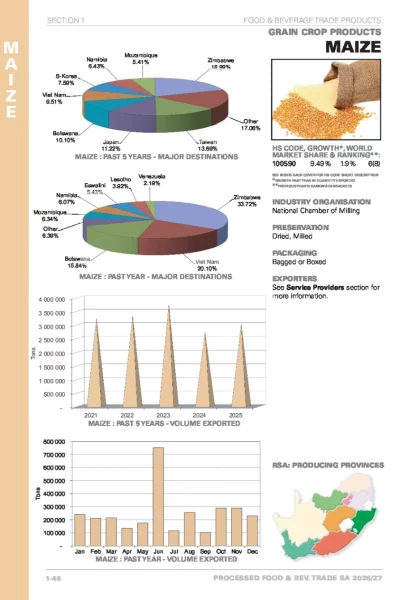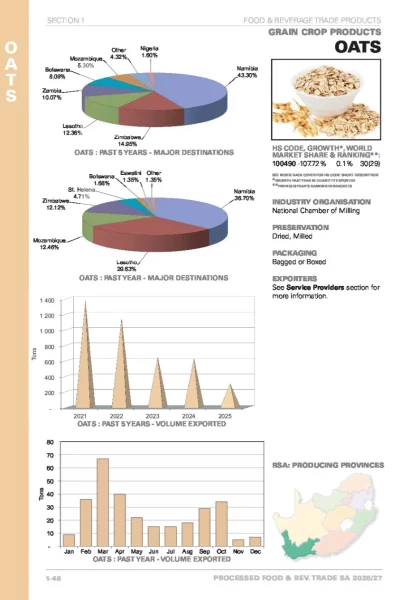
Introduction: From quiet phone to steady orders
Before dawn in the winelands, the to-do list already competes with the sunrise. Orders must be packed, labels checked, and deliveries planned. Between production and paperwork, discovery often falls to the bottom of the pile. That is where a Google Business Profile for a food business in South Africa earns its keep, turning local searches into calls, direction requests, and feet through the door.
Table of Contents:
TL;DR: Key Takeaways
- Claim and verify a Google Business Profile to show up in local searches and Maps.
- Complete core details, add strong visuals, and use attributes relevant to food service.
- Keep the profile active with posts and replies to reviews, then measure calls and requests.
Why a Google Business Profile matters for SA food businesses
A complete Google Business Profile food business South Africa listing makes it easier for customers to find a producer, deli, bakery, or tasting room at the exact moment they are searching. Local intent is high, which means fewer tyre-kickers and more shoppers ready to buy or book. Think of it as the digital shopfront that never sleeps and always points to the right door.
Local discovery, walk-ins, and trust signals
People browsing on mobile look for quick answers, clear directions, and visible proof of quality. Reviews, photos, and up-to-date hours do heavy lifting. When a profile shows fresh imagery, category accuracy, and consistent NAP details, it earns trust faster than a static web page. It also feeds map packs and discovery queries that drive direction requests.
Mobile reality in South Africa
South Africans commonly access the internet via mobile. Official data shows most households access the internet using mobile technology, which makes an accurate profile with click-to-call and directions even more valuable for an SME budget. Citing this reality anchors priorities on the essentials that convert. Confirm with Stats SA’s General Household Survey and ICASA’s ICT Sector Report.
Step 1: Check if a profile already exists
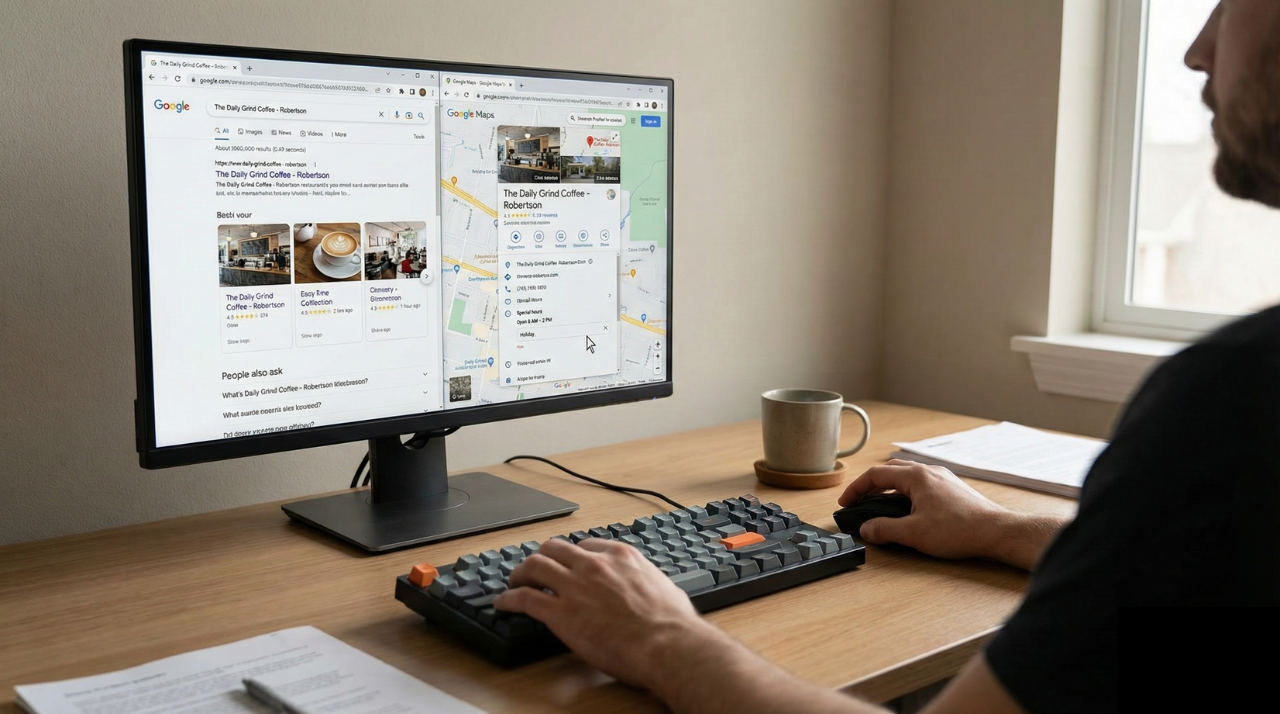
Search the business name plus city on Google Search or Google Maps. If a profile appears, open it and look for options to claim the listing. This avoids duplicates that confuse customers and dilute reviews. If an old profile exists with the wrong address or owner, request ownership rather than creating a fresh listing.
Avoid duplicate listings and ownership conflicts
Duplicates split reviews and reduce local ranking clarity. If a previous agency or staff member created the listing, follow the official ownership request process and provide proof when asked. Patience and accurate documentation speed resolution.
Step 2: Claim your Google Business Profile
On desktop, open Google Search or Google Maps, search the business name, and choose the relevant profile. Select the option to claim or manage the business. On mobile, open Google Maps, search the business, tap the profile, and choose the management prompt. These are the official routes to add or claim your Business Profile that unlock verification options.
Where to start on Search or Maps
The claim flow is similar on both products. Search, select the profile, and follow the prompts to confirm association with the business. Keep the company email ready and ensure you can receive calls or SMS on the official number during setup.
Step 3: Verify your Google Business Profile
Verification proves that the person managing the profile represents the business. Methods vary by category and risk level, including phone, SMS, email, postcard, or a short live video call that shows signage and premises. Choose the method offered and complete it promptly to unlock full editing rights using Google’s verification guide.
Phone, SMS, email, postcard, and video verification
If phone or SMS is offered, keep the device on hand to capture the code. For email, check the inbox linked to the domain. If video is requested, prepare to show street signage, entrance, and equipment or front-of-house. Difficult cases may require additional evidence, so keep utility bills or registration documents nearby. See video verification steps for what to show.
Step 4: Set core details that customers actually use
Accuracy is non-negotiable. Use the registered business name, relevant primary and secondary categories, and a concise description that mentions product types and service areas in plain language. Keep hours accurate and add special hours for public holidays to avoid wasted trips and angry reviews.
Name, categories, description, and service areas
Food and beverage categories are rich and specific. Choose a primary category such as Sauce Manufacturer, Butchery, Bakery, Tasting Room, or Deli. Add secondary categories sparingly when they add clarity. Use the description to highlight local ingredients, certifications, or delivery coverage without keyword stuffing.
Hours, public holidays, load-shedding updates
South Africans know the rhythm of public holidays and power cuts. Update special hours for holidays and use posts to flag service impacts during load-shedding. It is better to set accurate hours than to explain missed expectations later.
Step 5: Add visuals that sell the plate before the bite
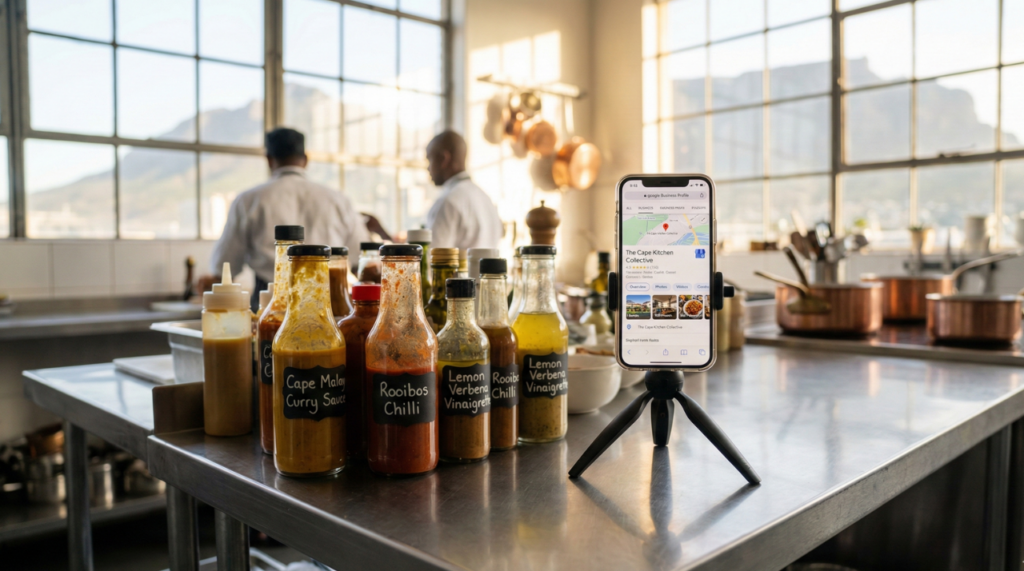
Photos should show the product in honest, natural light and the physical entrance so visitors recognise it from the street. Short videos that reveal process and quality cues build trust. Keep file names descriptive and add alt text that explains the subject for accessibility and image search context.
Photos, short videos, and alt text discipline
Aim for a mix: exterior, interior, team at work, product close-ups, menu boards, and packaging ready for dispatch. Replace dated images, avoid heavy filters, and maintain aspect ratios that render well on mobile. A simple routine of five fresh visuals a month keeps the profile looking alive.
Step 6: Use attributes and products for F&B specifics
Attributes help customers filter for what matters, from Halaal to vegan-friendly to wheelchair access. Product listings are useful for sauces, bakery items, beverages, and gift packs, each with a photo, price, and short description that mirrors labels on shelf.
Dine-in, takeaway, delivery, Halaal, vegan-friendly
Tick only what truly applies. Misleading attributes damage credibility and can lead to negative reviews when expectations are not met.
Product catalogues for sauces, bakery, beverages
Group items logically. Seasonal specials deserve their own set with clear dates, so customers are not disappointed by stockouts.
Step 7: Reviews that convert fence-sitters
Ask for reviews at natural moments, such as after a repeat order, a tasting, or a successful delivery. Provide a short link via the profile’s dashboard and request a photo when appropriate. Replies should be timely, polite, and specific to the order. A calm tone solves more than a defensive one ever will.
Asking ethically, replying professionally
Never offer incentives for reviews. Thank positive reviewers and address concerns with solutions. If a review is clearly mistaken or violates policy, flag it with context rather than trading barbs in public.
Step 8: Posts, Offers, and Q&A to keep the profile fresh
Use Updates for new flavours, harvest notes, or tasting dates. Offers work well for limited runs, bulk discounts, and seasonal hampers. Q&A is a public FAQ, so seed common questions and answer them clearly to save time later. A monthly cadence is sustainable for a small team.
Monthly cadence that fits an SMME schedule
Plan one Update, one Offer, and a Q&A refresh each month. Tie them to events customers recognise, like school holidays, pay-day weekends, or local markets.
Step 9: Track what works and fix what does not
Use profile Insights to see searches, views, calls, and direction requests. Add UTM parameters to website links so Analytics distinguishes profile traffic from other sources. When calls spike after a certain post type, repeat it. When direction requests dip, recheck hours, address pins, and exterior photos.
Insights, calls, direction requests, and UTM tags
South Africa’s mobile landscape keeps shifting. Mobile subscriptions remain high, which means click-to-call and map accuracy keep paying rent. Treat Insights as a weekly dashboard and act on small signals quickly.
Common pitfalls that trip up SA food businesses
- Creating duplicate listings instead of requesting ownership.
- Over-stuffing descriptions with keywords that read unnaturally.
- Ignoring special hours, which leads to avoidable one-star reviews.
- Posting once, then going quiet for months.
When the profile begins generating enquiries, upgrade the rest of the digital footprint. Use a practical trade overview to frame supply chain basics and partner types that suit the next growth step. Link product-ready readers to a national food trade directory for discovery opportunities and credible references. For owners rebuilding their web presence, bookmark guidance on food business website essentials so profile traffic lands on a conversion-ready site.
- Upgrade sourcing decisions with a practical trade overview that maps services, suppliers, and routes across South Africa.
- Shortlist credible partners using the food trade directory for South Africa to compare categories, regions served, lead times, and documentation.
- Ensure profile clicks convert by following the food business website guide for South Africa with mobile-first basics and quick wins.
- If listing on a directory is the next step, use the step-by-step listing guide for a food directory in South Africa to prepare content, proofs, and logistics info.
Conclusion
Claiming and verifying a Google Business Profile food business South Africa listing is a modest time investment with outsized returns. Keep details accurate, show the product honestly, and reply to reviews like future customers are reading, because they are. In a market where mobile search drives action, small consistent updates compound into visibility, trust, and sales. That is how a local producer turns everyday searches into steady growth.
FAQ
How long does verification take in South Africa?
It depends on the method offered. Phone or SMS can be instant, email is usually same day, postcard may take days, and a short video call depends on scheduling. Follow the method provided in the dashboard.
What if someone else already manages the profile?
Request ownership through the official process. Provide proof if Google asks, and avoid creating a duplicate listing to keep reviews in one place.
Which category should a small food producer choose?
Pick the most specific primary category that describes the main offer, such as Sauce Manufacturer or Bakery. Add a secondary category only when it adds clarity.
How often should photos be updated?
Aim for monthly refreshes. Replace old packaging shots, add seasonal products, and keep an exterior photo that matches the street view.
Do reviews really impact local ranking?
They are one of many signals. More importantly, they influence human trust. Ask ethically, respond professionally, and learn from patterns in feedback.
What metrics show if the profile is working?
Track calls, direction requests, website clicks, and queries in Insights. Add UTM tags to confirm how many orders or enquiries started on the profile.
Is a website still necessary?
Yes. The profile captures intent, while the website convinces and converts. Keep both aligned so customers get a consistent experience.