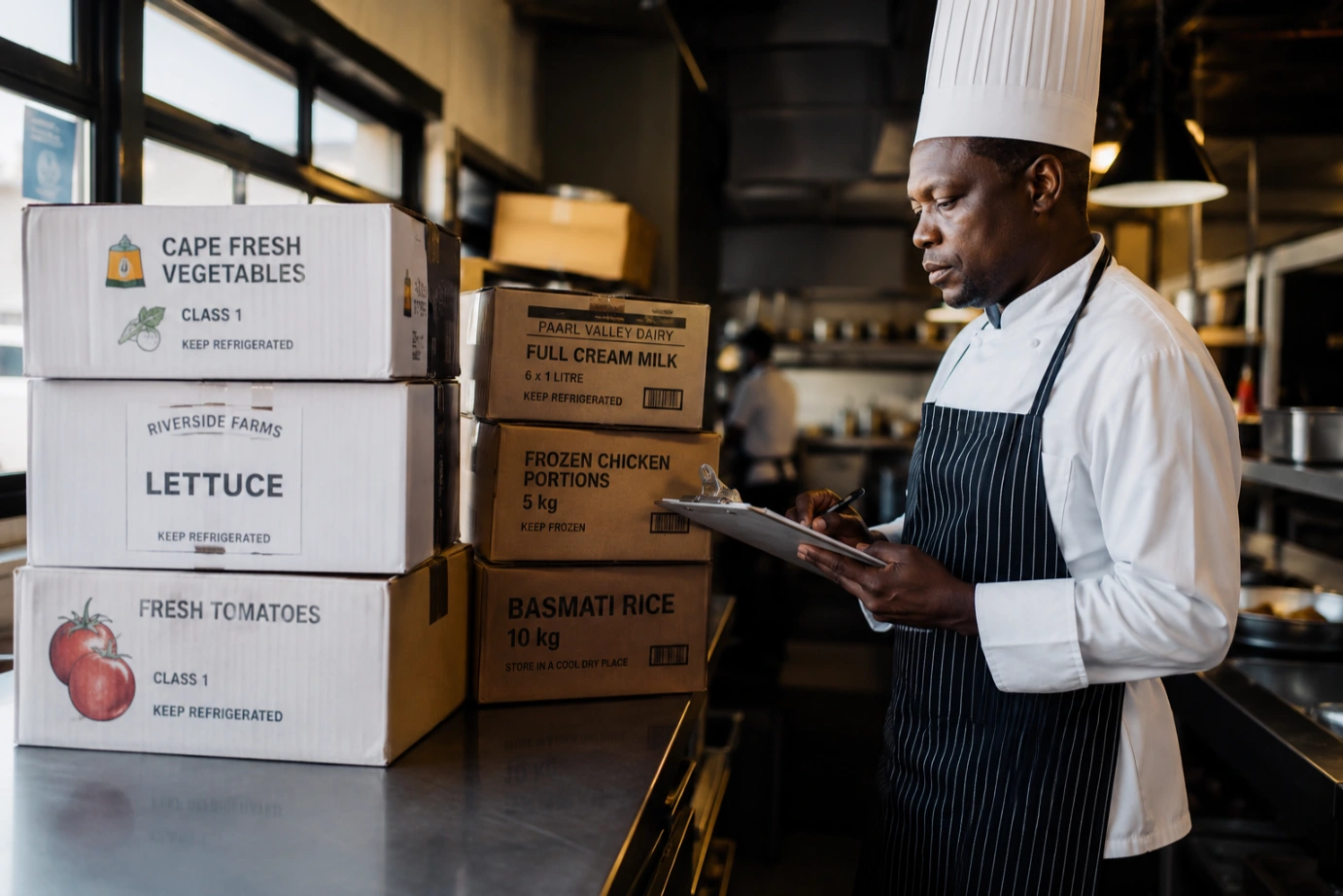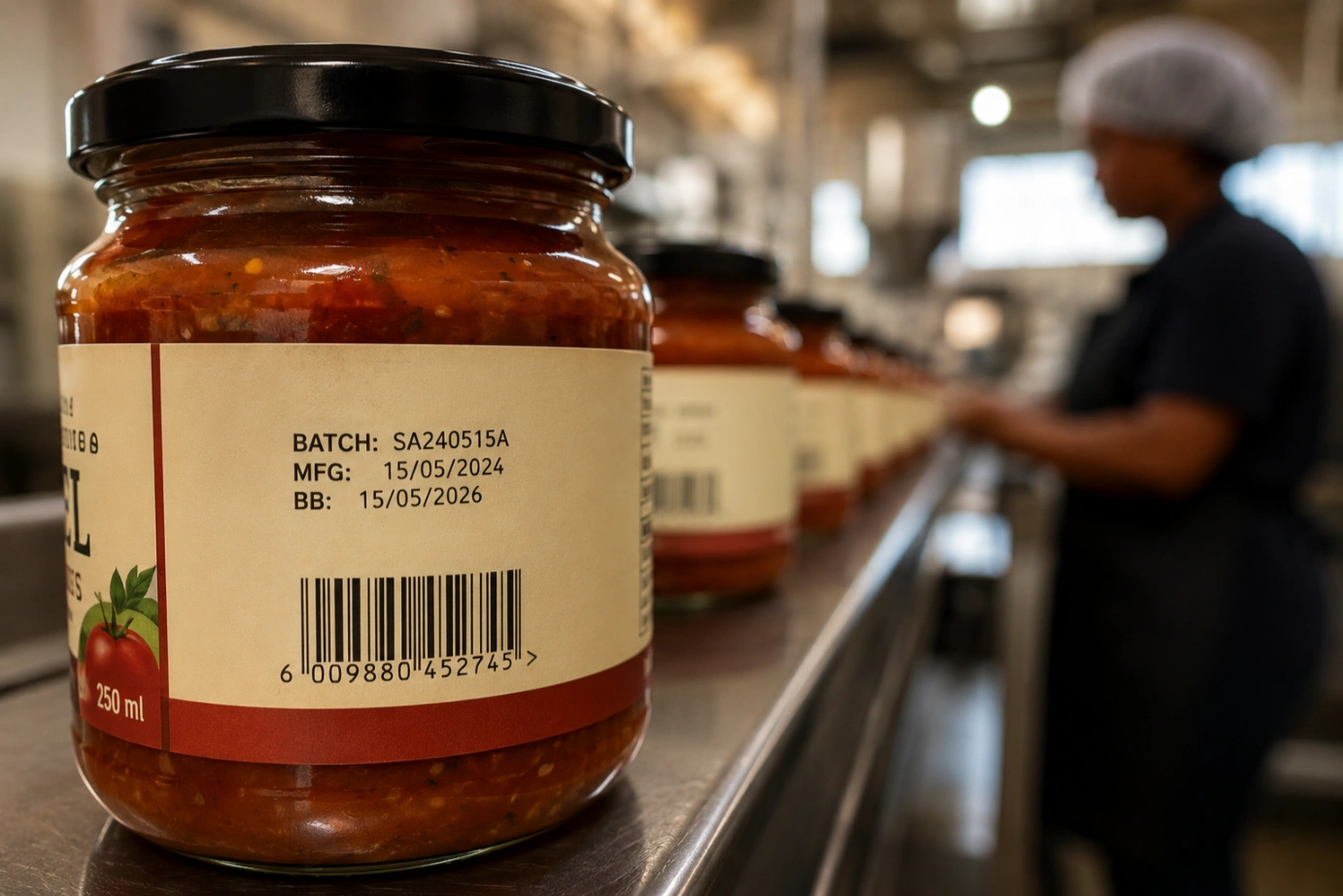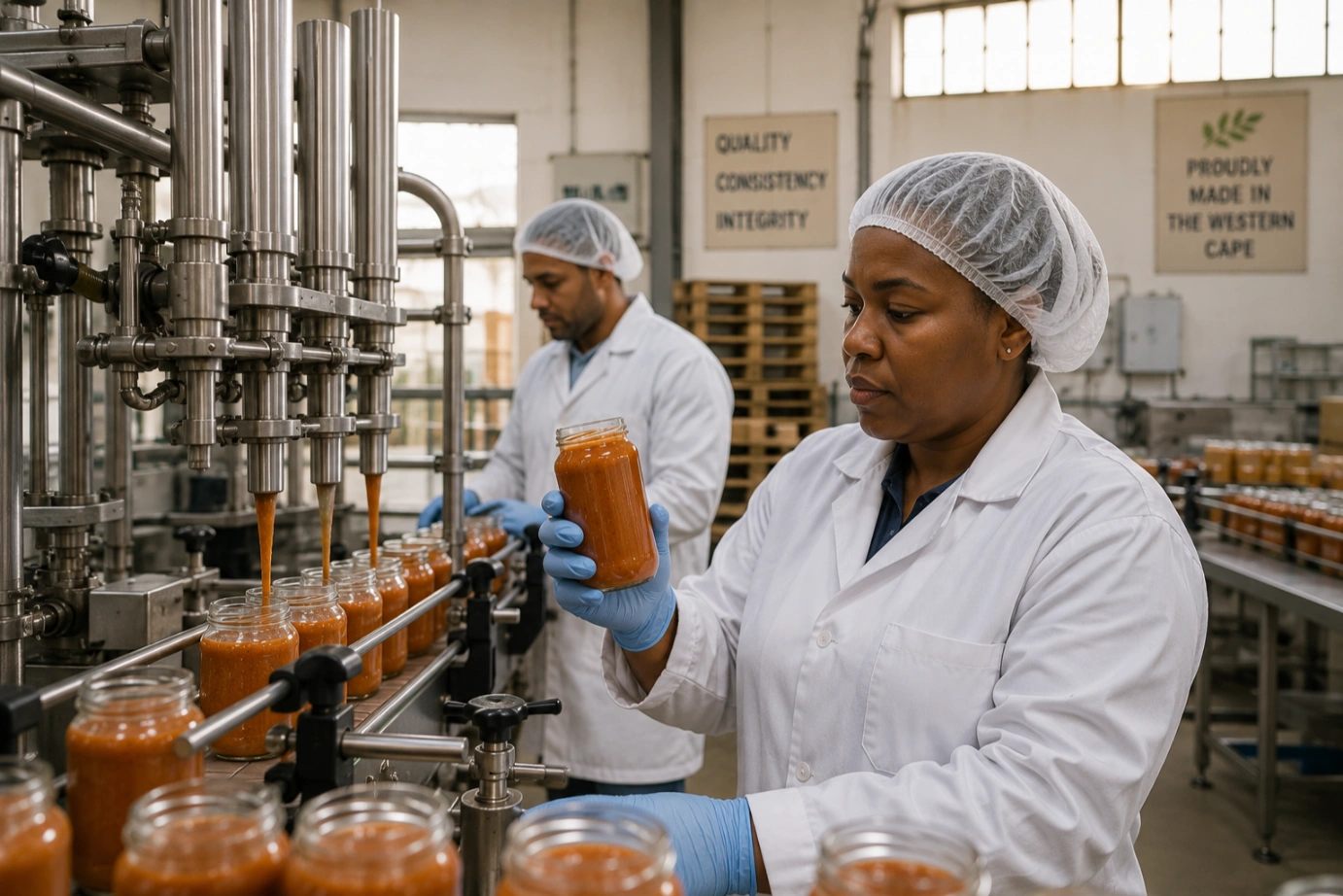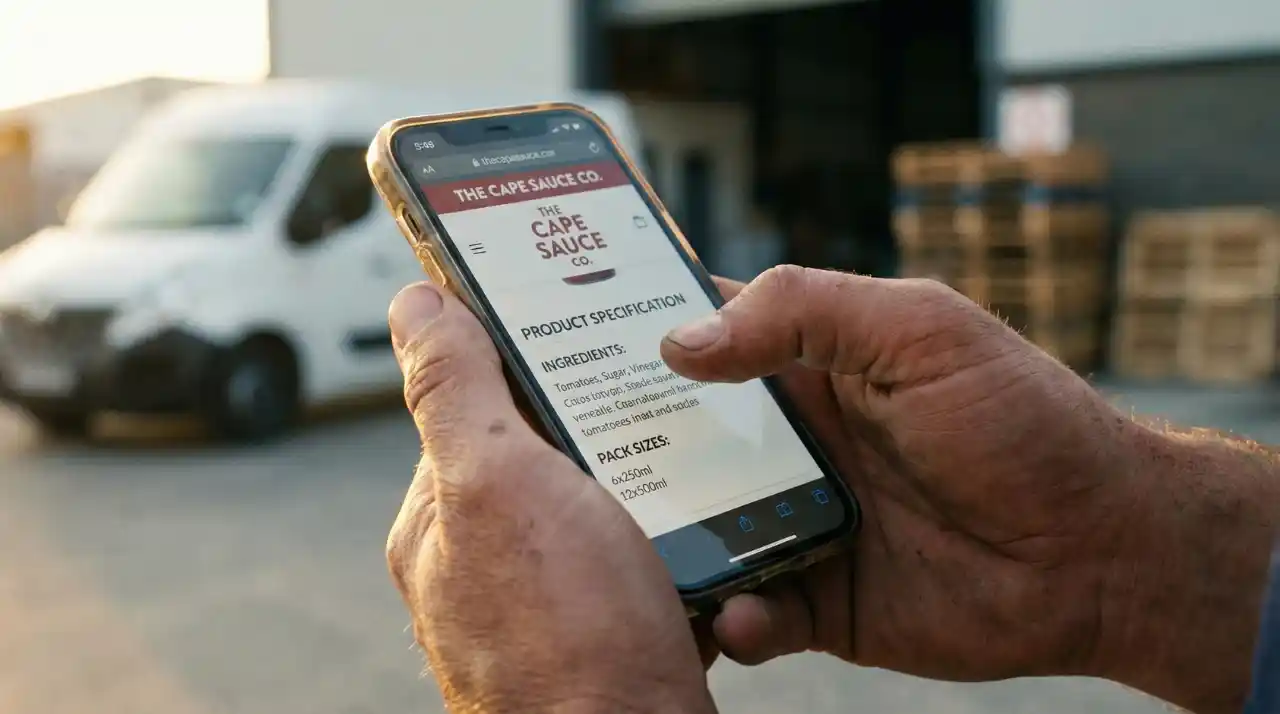
It is just after 5 a.m. in the Stellenbosch winelands, and a small sauce facility is already in motion. Orders are being packed, labels are being double-checked, and the day’s delivery route is being discussed while the kettle boils. A buyer message arrives on WhatsApp asking two quick questions: “What is the lead time?” and “Can chilled delivery to Gauteng be arranged?” In that moment, a food business website South Africa is either the calm, clear answer or the reason the buyer moves on to the next supplier.
This guide sets out a minimum viable, buyer-ready website checklist for South African SMEs that sell food and beverages. It stays practical, mobile-first, and rooted in the realities of transport, cold chain, and tight buying windows. The goal is not to build a flashy brochure, but to build a working sales and operations tool that reduces back-and-forth. Every section below links website choices back to how products are stored, shipped, and supplied.
Table of Contents:
TL;DR: Key Takeaways
- Mobile-first design matters because buyers often research suppliers on phones during short breaks in a busy day.
- Logistics clarity on the website reduces friction and prevents failed deliveries and mismatched expectations.
- Trust signals and compliance cues speed up supplier vetting and improve enquiry quality.
- A simple, maintainable website stays accurate and credible when operations are under pressure.
Start with the buyer journey, not the look and feel
A beautiful website can impress, but a useful website closes deals. Most buyers land on a home page, scan for product fit, jump to product details, and then look for proof and delivery practicality.
If those answers are buried, a simple enquiry becomes a long email thread that steals time from production. If the answers are obvious, the buyer can move to samples, pricing, and a first trial order.
A food business website South Africa should be planned like a short walk, not a maze. The walk needs three signposts: what is being sold, why it is consistent and safe, and how it is supplied across regions.
That last signpost is often missing, because delivery details sit in someone’s head and not on the page. Making logistics visible early reduces confusion and improves lead quality.
The 90-second test buyers use on a phone
Picture a procurement manager scrolling between meetings. The first question is “what category is this and what makes it different?” The second question is “can this be delivered reliably to the regions being served?”
The third question is “is this supplier trade-ready, or will the first order be a mess?” If those answers are not clear within 90 seconds, many buyers simply exit and keep searching.
To pass the test, add a short “buyer snapshot” panel on key pages. It can include pack sizes, storage conditions, allergens, MOQs, typical lead times, and delivery temperature requirements where relevant.
This is not marketing fluff, it is operational clarity. It also reduces time wasted on enquiries that cannot be fulfilled.
The minimum pages every SME website needs
A minimum-viable site is not many pages, but each page must do real work. The essential pages are Home, Products, About, Contact, and a Logistics and Ordering page that answers transport questions upfront.
A food business website in South Africa can also add a “Trade Ready” page that bundles proof points and document availability in one place. That is often where distributors decide if a supplier is ready for a trial run.
To see how buyers scan supplier information, it helps to look at a directory-style layout like the Food Suppliers in South Africa. The structure makes it easy to identify fit, understand categories, and take a clear next step.
That same structure can be copied in principle, even on a small website. Keep navigation short, labels clear, and calls-to-action easy to tap.
Home page: the “can this supplier deliver?” answer
A home page should not start with a life story. It should state the product categories, who they serve, and what regions can be supplied.
It should also mention whether products are ambient, chilled, or frozen, because cold chain changes how buyers plan and budget. A buyer should be able to tell within seconds whether this supplier fits a route-to-market need.
Add two proof points that are true and specific, such as “batch coding on every unit” or “COAs available for key batches.” Vague badges often feel salesy, while specifics feel operational.
Place one main call-to-action above the fold, such as “Request a spec sheet” or “Ask for a sample quote.” Include a WhatsApp option, because many SME transactions move faster through direct messaging.
Product pages: make specs and logistics easy to scan
Product pages win or lose the deal because they answer practical questions. Include pack size, ingredients, allergen statements, shelf-life guidance, and storage conditions in plain language. Add the usual order lead time, and mention whether urgent top-ups can be supported when retailers call for last-minute replenishment.
If a product requires chilled delivery, state the required temperature band and handling notes without overcomplicating the wording.
Buyers also want consistency, so include a short note on how quality is controlled during packing and dispatch. For example, mention “sealed outer cartons,” “tamper evidence,” or “temperature monitoring on request” if that is accurate.
For a clear example of how co-packing and manufacturing models are explained to buyers, see the beverage manufacturing companies in South Africa resource. The key lesson is clarity: what is made, what controls exist, and what the buyer can expect at delivery.
About page: credibility without the waffle
The About page should prove capability, not charm. Describe what the facility does, what capacity looks like in practical terms, and how seasonality affects production planning.
Buyers appreciate knowing how raw material availability is managed, because shortages often create delivery delays. It helps to describe how substitutions are handled, how lead times are communicated, and what happens when demand spikes.
A food business website in South Africa can also connect the business to the broader trade ecosystem without sounding grand. A useful reference point is the overview of the food and beverage industry in South Africa, which frames how suppliers, buyers, and services connect across the country.
That context can help explain why reliability matters and how the business supports buyers across regions. Keep wording direct and grounded in day-to-day operations.
Contact page: design it like an operations handover
A Contact page should work like a mini-brief that helps quoting and planning. Include a short form that asks for region, product, estimated volume, required temperature band, and target delivery date.
Add a WhatsApp button with a pre-filled message that prompts the same details, because structured messages reduce confusion. Make contact details easy to copy, and make the page readable even on a small screen.
Operational details belong here too. Include loading hours, collection options, and where samples can be collected or couriered from. If deliveries are done through partners, describe the typical process and what information is needed to confirm cost.
A food business website South Africa should treat contact as a conversion system, not an afterthought. A buyer who can get an accurate quote quickly is a buyer who is more likely to place a first order.
Logistics and Ordering page: the trust-building shortcut
This page is where many SMEs gain an edge, because it answers the awkward questions before they are asked. Describe delivery zones, dispatch days, typical lead times by product type, and how order cut-off times work.
If a 3PL partner handles national distribution, mention the service model and what the buyer can expect. If self-delivery is used locally, state the radius and the conditions.
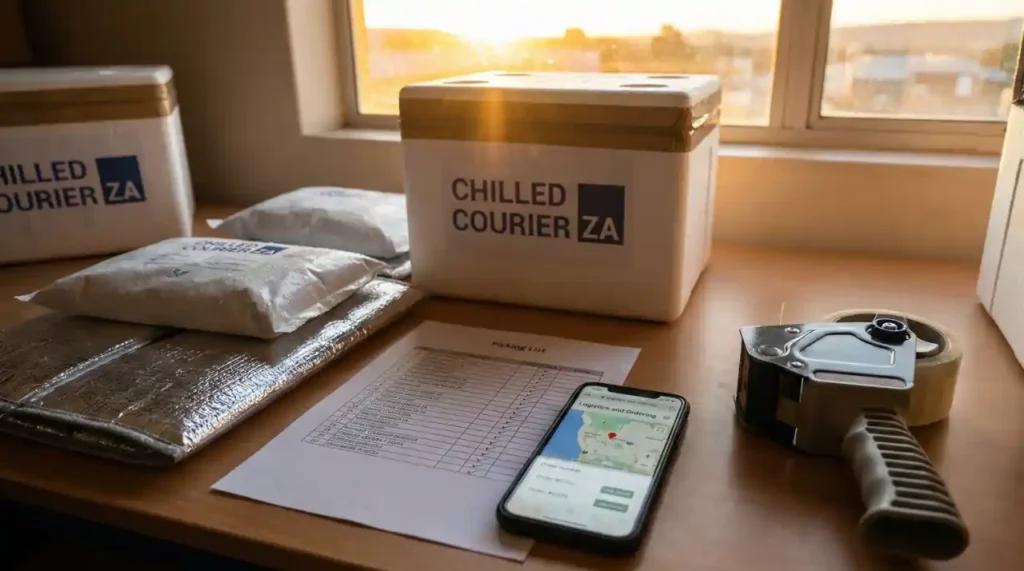
Also include cold chain handling notes where relevant. If chilled products are packed with gel packs, insulated liners, or temperature monitoring, say so plainly and only when it is true.
Load shedding is a reality, so include a short statement on how temperature-sensitive stock is protected during outages. These details make a food business website in South Africa feel buyer-ready because they mirror the questions buyers ask when risk matters.
Mobile-first is not optional in South Africa
Mobile-first is not a trend, it is how business is done. Statistics South Africa’s General Household Survey 2024 reports that access to the internet through mobile broadband increased from 28.0% in 2010 to 82.1% in 2024.
That means buyers, drivers, and operations teams are often using phones to check specs, confirm delivery details, and message suppliers. If a website feels slow, cramped, or confusing on a phone, it is effectively invisible.
ICASA’s State of the ICT Sector Report of South Africa 2025 also shows the scale of smartphone use in the country, with aggregated figures listing smartphone subscriptions at 82,742,112. The practical takeaway is simple: test the site on an entry-level Android phone and average mobile data.
If the site works with noisy signal, small screens, and quick thumbs, it will work for buyers under pressure. A food business website South Africa should be built for real-world browsing, not for perfect office connectivity.
Mobile essentials that protect conversion
Start with speed, because slow pages lose impatient buyers. Use compressed images, avoid heavy sliders, and keep fonts clean and readable.
Make buttons large enough for thumbs, and keep the primary call-to-action in a consistent position across pages. Ensure the phone number and WhatsApp button are clickable, because copying and pasting is a friction point.
Each of these essentials links back to transport and operations. Buyers check suppliers while waiting for deliveries or walking a warehouse floor, so speed matters.
Drivers and field teams may check pickup instructions on the move, so readability matters. A food business website in South Africa that behaves like a reliable teammate under pressure will convert more consistently.
Trust signals that matter for food buyers
Trust is built through specifics, not slogans. Buyers want to see what is produced, how it is controlled, and how it is delivered without surprises.
That means clear statements on allergen control, traceability, recall readiness, and quality checks at dispatch. It also means clarity on how orders are packed, labelled, and transported so that shelf life is protected.
A practical trust signal is to show how information is organised, not only what is claimed. For producers who align with industry directories, it helps to reference relevant guide assets in a factual way.
For example, fresh category businesses can reference Fresh Food Trade SA as a directory-style resource that buyers use for shortlisting. Keep claims accurate and simple, because credibility is fragile when buyers have many options.
Document readiness without legal overload
A website is not a compliance manual, but it can show that compliance is taken seriously. Use simple cues such as “allergen statements available,” “product specs available,” and “COAs shared for relevant batches.”
If certifications exist, list them clearly and be ready to share proof when asked. If certifications are in progress, describe that neutrally and avoid making promises that cannot be kept.
Logistics should be part of the trust story too. Buyers trust suppliers who state cold chain requirements, delivery temperature limits, and shelf-life handling instructions.
Buyers also trust suppliers who explain what happens during load shedding and how temperature control is protected. A food business website South Africa can include a short “cold chain note” for sensitive products, and that can prevent expensive misunderstandings.
WhatsApp and enquiry flows that convert
Many SME deals start in WhatsApp because it is fast and familiar. The risk is that chats become messy threads with missing details, which slows quoting and increases errors.
A website can prevent this by using a WhatsApp link that opens a structured, pre-filled message. That message should request region, product, volume, temperature needs, and target delivery date.
The same structure should be used in the contact form. Keep the form short and ask only for what operations needs to price and plan.
Provide two pathways, “Request a quote” and “Request samples,” because buyers often want to test before committing. A food business website in South Africa becomes more efficient when it collects the right information upfront, especially when a small team is wearing many hats.
A 48-hour response rule that supports buying cycles
Speed of response is a competitive advantage, especially when buyers are building shortlists. Set an internal standard that every website enquiry gets a first response within 48 hours.
If that is not always possible, set expectations with an automatic acknowledgement that confirms receipt and states the next step. Include what will be sent next, such as a spec sheet, allergen statement, and delivery policy.
This response rhythm connects directly to logistics. Retail and distributor windows can be tight, and delays in communication become delays in trial orders and deliveries.
A food business website in South Africa can support a predictable rhythm by placing templates and checklists in the right places. Even a small team can look organised when the process is consistent.
Local SEO basics for “nearby” and “supplier” searches
Local SEO is not only for restaurants and shops. Food buyers often search by region because transport costs matter and lead times are real.
A producer may be based in the Western Cape, but supply to Gauteng or KwaZulu-Natal through partners, and the website should say this clearly. Add a Google Business Profile, keep address and contact details consistent across platforms, and use location phrases naturally.
A food business website in South Africa should include a simple service area statement. It can list key metros, provinces, or corridors, and explain how delivery is handled, such as chilled courier, 3PL distribution, or direct delivery in a local radius.
This content helps match real search intent and reduces enquiries from regions the business cannot serve yet. It also protects margin by avoiding unprofitable routes and emergency deliveries.
Structured content that helps AI search understand the business
AI search systems summarise suppliers by extracting clear answers. That means headings, short subheadings, and consistent wording matter.
Add a short FAQ block on key pages for common operational questions, such as “What is the MOQ?” and “How is cold chain handled?” These are the exact questions buyers ask, so they also improve conversion.
Schema markup can help when content is accurate and stable. Use Organisation and LocalBusiness schema, then add Product schema for key products if pack sizes and details are not changing weekly.
Avoid keyword stuffing, because it reduces trust and readability. A food business website South Africa performs better when it answers questions naturally and consistently.
A simple sitemap and navigation that keeps things sane
Navigation should be short enough for phone users and busy buyers. Use five to seven menu items, group products logically, and keep labels clear.
Add a footer that repeats key links, because many users scroll to the bottom when looking for contact details. A clean sitemap also helps search engines crawl the site reliably, which supports long-term visibility.
Internal linking should be purposeful, not random. When writing content about distribution or procurement, link to relevant hub resources, for example, on Food and Beverage Trade South Africa, a hub resource would be Food Trading and Distribution Services, because it aligns with buyer intent.
This follows a hub-and-spoke approach that concentrates authority and makes discovery easier.
Copy templates that keep pages consistent
Templates keep content consistent when the week gets hectic. A home page template can use four sentences: what is made, who it serves, where it is supplied, and how to enquire.
A product page template can cover pack size, ingredients, allergens, shelf life guidance, storage, lead time, MOQ, and delivery method. A logistics template can list delivery zones, dispatch days, courier or 3PL model, and what information is needed for accurate quotes.
Templates also support scale. When a new SKU is launched, the page can be created quickly without reinventing the wheel. When a distributor asks for a spec sheet, the same content can be reused in a PDF.
A food business website South Africa becomes a single source of truth, which reduces internal confusion and external back-and-forth.
The buyer-ready launch checklist before going live
Before publishing, test the site like a buyer. Load the pages on a phone with average signal and confirm the key pages load quickly. Tap every button and make sure the WhatsApp message is pre-filled properly. Read the product pages and check whether allergens, pack sizes, lead times, and delivery notes are easy to find.
Then test it like operations. Confirm that the contact form collects enough information to plan delivery and quote accurately. Check that delivery zones match what transport partners can realistically support, including chilled routes if needed.
Make sure stock handling notes match what actually happens in the facility during load shedding or peak season. A food business website in South Africa should reduce risk and reduce workload, not create new problems.
Conclusion
A buyer-ready website is built by solving the same problems buyers face every day. For South African SMEs, those problems are practical: uneven connectivity, tight delivery windows, and a constant need for trustworthy proof. A food business website South Africa that is mobile-first, clear on logistics, and honest about capability makes it easier for buyers to say yes. That is the real win, because it turns attention into a working relationship that can grow.
The next step is to publish the minimum pages, then improve one page per week based on real enquiries. Keep proof points updated, treat logistics clarity as part of the brand promise, and make it easy to request quotes and samples. When the next WhatsApp message lands before sunrise, the website will already have answered the first questions. The business can then focus on producing well and delivering reliably.asics are done well, the website becomes a quiet partner in smoother deliveries and steadier growth.
FAQ
How many pages should a food SME website have at minimum?
A practical minimum is five pages: Home, Products, About, Contact, and Logistics and Ordering. This is enough to answer buyer questions about product fit, proof, and delivery without creating a maintenance burden. Extra pages are useful only when they reduce friction, such as a Trade Ready page that lists what documents are available on request. If content cannot be kept current, fewer pages with better clarity usually performs better.
What pages should be prioritised first for a food SME that delivers across provinces?
Start with a product range page, a wholesale and trade page, and a delivery expectations page, because those answer buyer questions fastest. Add a compliance overview page to support due diligence and reduce risk concerns. A clear contact page should include service regions and response expectations so procurement teams can act quickly. These pages reduce admin pressure by preventing repeated questions.
How can a website reduce failed deliveries and disputes?
Spell out cut-off times, dispatch days, and delivery windows clearly and keep them updated. Include receiving checks and damage reporting steps so problems are handled consistently. Add cold chain notes where applicable so buyers know how products are packed and what to expect on arrival. Clear expectations reduce surprises that create conflict.
What’s the most important page after the homepage?
For most food SMEs, it’s the Products or Catalogue page, followed closely by Certifications & Compliance. Buyers want specs, pack sizes, delivery areas, and proof that risk is managed. Clear contact routes and promised response times complete the trust picture. When those pieces exist, the homepage simply becomes a fast gateway.
How can a site handle load-shedding disruptions?
Use a reliable host, enable caching and a CDN, and keep images small. Display operational notices when power schedules affect fulfillment. Provide multiple contact channels so buyers can still reach the team. Uptime monitors with SMS alerts help you react before customers notice issues.
Should pricing be listed publicly on a B2B food website?
Many food SMEs keep pricing behind a trade enquiry because pricing can vary by volume, region, and channel. A better approach is often a clear “request a trade price list” action combined with transparent MOQs and lead time guidance. This filters for serious buyers while keeping communication consistent. If pricing is listed, it must be kept accurate to avoid disputes.
What are the most important trust signals for retailers and distributors?
Clear contact details, service regions, lead times, and pack formats build trust immediately. Compliance cues such as allergen handling and traceability notes reduce risk concerns. Honest delivery expectations and a professional damages process also signal maturity. Buyers want reliability and clarity more than marketing claims.
How often should a food SME update the website?
A monthly check is usually enough if it is consistent. Update product changes, pack formats, and delivery notes as they change, and test forms to confirm enquiries are coming through. Keep key pages accurate so buyers do not receive outdated information. Small, steady maintenance beats big redesigns that never get finished.