Food supply chain management is the day-to-day work of getting product from a supplier to a customer in the condition, quantity and timeframe you promised, and being able to prove afterwards what happened to it. This page sets out how to run that process. It covers demand planning, supplier selection, receiving, inventory rotation, storage, transport, delivery and traceability, with the controls and records that hold each stage together.
It is deliberately operational. For the structural pressures on South African food supply chains, see SA food supply chain challenges. For transport and distribution specifically, see food logistics in South Africa. For shorter local sourcing routes, see local food supply chains in South Africa.
Key takeaways
- Most food businesses run the same eight stages, from demand planning to traceability. Problems usually trace back to a stage where nobody owns the decision or nobody keeps the record.
- Food transport in South Africa falls under R638 of 2018. Regulation 13 covers the vehicle compartment, and the temperature limits are set by product category rather than as one figure for all food.
- Plan for ordinary interruptions, not only dramatic ones: power, vehicle failure, supplier shortfall and a quality problem found after dispatch, each with a named decision-maker and a fallback.
- Four measures cover most needs: on time in full, delivery acceptance rate, stock loss and trace exercise result. Set targets from your own baseline.
The workflow, end to end
Most food businesses run the same eight stages, whether they move two pallets a week or two hundred. Problems usually trace back to a stage where nobody owns the decision or nobody keeps the record.
- Demand planning. Decide what you expect to sell, over what period, and how confident you are. Plan separately for lines with short shelf life.
- Supplier selection and onboarding. Confirm who the counterparty actually is, what they are able to supply, and what documentation they can produce on request.
- Ordering and inbound scheduling. Agree quantities, delivery windows and what counts as an acceptable delivery before the vehicle arrives.
- Receiving. Check the load against the order and against your acceptance criteria, and record the result whether it passes or fails.
- Inventory and rotation. Know what you are holding, where it sits, and which batch moves next.
- Storage. Hold product under conditions appropriate to the product, and keep evidence that those conditions held.
- Transport and delivery. Move product without contaminating it, and hand it over with a record that both sides accept.
- Traceability and exceptions. Be able to work backwards from a batch to its supplier and forwards to its customers, and have a defined response when something goes wrong.
Stage-by-stage control table
One control and one record per stage is usually enough to start. The responsible role is a suggestion, not a rule: in a small business one person may hold several of these.
| Stage | Practical control | Evidence or record | Suggested responsible role | Exception response |
|---|---|---|---|---|
| Demand planning | Forecast by line for a fixed period, flagged separately for short-shelf-life items | Dated forecast with the assumptions written down | Owner or sales lead | Re-forecast and tell procurement before the next order cycle |
| Supplier selection | Confirm legal entity, what they supply, and which documents they can produce | Supplier file with company details and dated document copies | Procurement | Hold the account until the gap is closed, or approve it in writing with a review date |
| Ordering | Written order stating quantity, specification, delivery window and acceptance criteria | Purchase order and the supplier acknowledgement | Procurement | Confirm in writing before dispatch, not after arrival |
| Receiving | Check quantity, condition, temperature where relevant, and batch or lot identification | Signed goods received note with the checks recorded | Receiving or store | Reject or quarantine, record the reason, notify the supplier the same day |
| Inventory rotation | First expired first out, with a defined location for each batch | Stock record showing batch, location and date | Store | Investigate any variance above your agreed tolerance and record the outcome |
| Storage | Hold at the condition the product requires and monitor it | Temperature or condition log with the monitoring interval stated | Store or warehouse | Isolate affected stock, record the deviation, decide on disposition before release |
| Transport and delivery | Clean, uncontaminated compartment, product protected, condition maintained in transit | Delivery note plus vehicle or load check record | Logistics or carrier | Refuse the load, record it, and raise it with the carrier under the agreed terms |
| Traceability | One step back to the supplier, one step forward to the customer, per batch | Batch register linking supplier lot to outbound consignment | Whoever owns the stock record | Run a trace exercise, then act on the result rather than filing it |
Condition and temperature: what the regulations actually say
There is no single temperature that applies to all food, and any supplier or checklist that offers you one is oversimplifying. The relevant instrument for food handled and transported in South Africa is the Regulations Governing General Hygiene Requirements for Food Premises, the Transport of Food and Related Matters (R638, published 22 June 2018), made under the Foodstuffs, Cosmetics and Disinfectants Act 54 of 1972.
Two parts of R638 matter most for supply chain work. Regulation 13 sets requirements for the vehicle compartment: it must be clean enough that chemical, physical or microbiological contamination is prevented, and food may not be carried together with contaminated food, waste food, poison, harmful substances, live animals or contaminating objects. Where unpacked or unwrapped food is carried, the compartment interior must be smooth, rust-free, non-toxic, non-absorbent and without open joints, and it may not carry people or contaminating items at the same time. Regulation 12 sets stricter conditions again for meat, including vehicles used exclusively for meat and carcasses hung clear of the floor.
Annexure E of R638 sets core temperatures by product category rather than one universal figure. It distinguishes frozen products, with a separate limit for ice cream and sorbet, from chilled categories, where raw fish, molluscs, crustaceans, poultry and milk sit at a tighter limit than other perishables, and it sets a minimum for food held hot. Read Annexure E directly against your own product list and confirm the exact figures in the gazette before you write them into a specification or a supplier agreement.
Export consignments carry a separate layer. The Perishable Products Export Control Board performs cold chain services under the Perishable Products Export Control Act 9 of 1983, and inspection and food safety functions under the Agricultural Products Standards Act 119 of 1990, for regulated plant products intended for export. That mandate is export-facing, so do not assume PPECB involvement covers a domestic delivery.
Third-party certification such as FSSC 22000 or BRCGS is a different category again. It is normally a customer or retailer requirement rather than a general legal one, and a certificate evidences an audited system against a defined scope on a defined date. Our comparison of BRCGS and FSSC 22000 sets out where they differ.
Contingency planning
Plan for the interruptions that are ordinary in this market rather than the ones that are dramatic. For each, decide in advance who makes the call and what the fallback is.
| Interruption | Decide in advance | Record to keep |
|---|---|---|
| Power interruption affecting chilled or frozen storage | Backup power or an alternative store, the maximum acceptable interruption, and who authorises moving stock | Duration, temperatures through the event, and the disposition decision for affected stock |
| Vehicle breakdown or delivery failure | Alternative carrier, and the point at which you divert the load rather than wait | Time of failure, action taken, and condition of product on arrival |
| Supplier short-supplies or fails | Approved alternative supplier per critical line, and who is authorised to buy outside the normal list | Shortfall quantity, substitute used, and cost or specification difference |
| Product quality problem found after dispatch | Who calls a hold, how customers are contacted, and the trace exercise you run first | Batch numbers affected, customers supplied, and quantities recovered |
A small KPI scorecard
Four measures cover most of what a food business needs to see. Define the numerator, the denominator and the period explicitly, write the definition down, and do not change it quietly between reporting periods. These are definitions, not targets: set your own targets from your own baseline rather than adopting a benchmark you have not measured.
| Measure | Numerator | Denominator | Period | What it tells you |
|---|---|---|---|---|
| On time in full (OTIF) | Order lines delivered both on the agreed date and at the full ordered quantity | All order lines due in the period | Weekly or monthly | Whether you are meeting the promise you actually made |
| Delivery acceptance rate | Deliveries accepted without rejection or claim | All deliveries received in the period | Monthly | Inbound supplier and carrier reliability |
| Stock loss | Units or value written off, expired, damaged or unaccounted for | Units or value available to sell in the period | Monthly | Rotation discipline and storage condition |
| Trace exercise result | Batches traced one step back and one step forward within your agreed time limit | Batches tested in the exercise | Per exercise, at least annually | Whether your records would hold up in a real recall |
Two cautions. Do not average an average: if you report OTIF by customer and then want a total, rebuild it from the underlying line counts. And record the period boundaries you used, because a measure taken over four weeks and one taken over a calendar month are not comparable.
A checklist you can work through
Use this to find the gaps. Working through it does not establish legal compliance, and it is not a substitute for reading the regulations that apply to your products or taking your own advice.
- Every critical line has a named primary supplier and at least one approved alternative.
- Each supplier file holds the legal entity name, the products they are approved for, and dated copies of the documents you asked for.
- Your purchase orders state acceptance criteria, not just quantity and price.
- Receiving staff know what to check, and record the check when the load passes as well as when it fails.
- Rotation runs on first expired first out, and the stock record shows batch and location.
- Storage conditions are monitored at a stated interval, and the log is reviewed by someone, not just filled in.
- You know which of your movements are covered by R638 transport requirements and which of your products fall under which Annexure E category.
- You can trace one step back and one step forward for any batch, and you have tested it at least once in the past year.
- Every stage above has a named owner, and the exception response is written down rather than assumed.
Where to go next
Storage decisions, and the difference between ambient and cold storage, are covered in food grade warehousing in South Africa. Record-keeping expectations that buyers commonly set are in food traceability standards. If you need outside capacity for cold storage, transport, testing or inspection, start with fresh food service providers. If you are onboarding a new counterparty, the supplier vetting checklist pairs with the supplier selection stage above.
Food supply chain management: frequently asked questions
What is food supply chain management?
It is the day-to-day work of getting product from a supplier to a customer in the condition, quantity and timeframe promised, and being able to prove afterwards what happened to it.
What are the stages of a food supply chain?
Demand planning, supplier selection and onboarding, ordering and inbound scheduling, receiving, inventory and rotation, storage, transport and delivery, and traceability and exceptions. Each stage needs an owner, a control and a record.
At what temperature must food be transported in South Africa?
There is no single temperature for all food. R638 of 2018 sets limits by product category, with separate figures for frozen products, ice cream and sorbet, chilled categories and food held hot. Read the annexure against your own product list and confirm the exact figures in the gazette before writing them into a specification.
What are best practices in food and beverage supply chain management?
Give every stage a named owner and a record, rotate stock deliberately, agree in advance who decides during an interruption, and measure the same few indicators consistently. The food logistics in South Africa page covers transport and distribution in more depth.
How do you measure food supply chain performance?
Use a small scorecard: on time in full, delivery acceptance rate, stock loss and trace exercise result. Define the numerator, denominator and period for each, and do not change the definition between reporting periods.
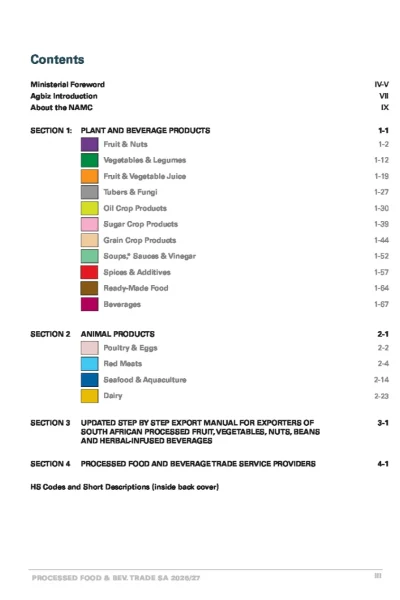
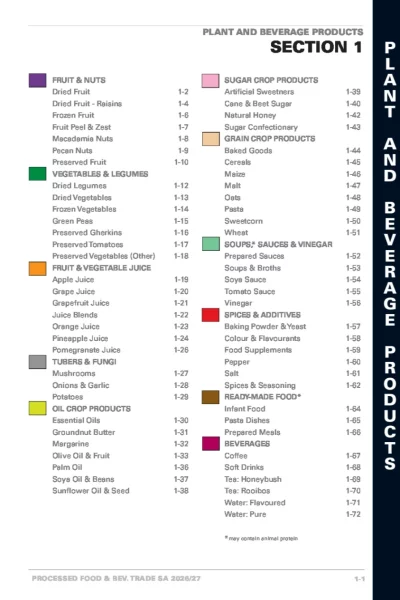
Get the trade guide
Fresh Food Trade SA is our published guide for the fresh side of this market. The guide page sets out what the current edition covers, so you can judge whether it is relevant before you download it.