Food Logistics in South Africa: Cold Chain, Regulations & Last-Mile Trends
Why food logistics in South Africa matters more than ever
Food logistics in South Africa is the invisible backbone that keeps supermarket shelves full, quick-service kitchens stocked, and export containers moving through local ports. From fresh fruit and vegetables to chilled beverages, ambient groceries, frozen foods, and high-risk products such as meat and dairy, every link in the chain relies on the right temperature, timing, and traceability. Because the country is large, with major agricultural regions far from coastal harbours and key consumption hubs, food logistics in South Africa must handle long road legs, mixed loads, and complex routing while ensuring products within specification. When this is done correctly, businesses avoid rejected loads, brand damage, and unnecessary write-offs, and can instead focus on growth.
South African conditions add a few extra curveballs, making food logistics in South Africa more challenging than in many other markets. High summer temperatures, regional infrastructure gaps, and power instability increase risk in both warehousing and transport stages. At the same time, exporters must comply with stringent requirements from destination markets, often linked to South Africa’s official assignee, the Perishable Products Export Control Board (PPECB), which certifies perishable exports and monitors cold chain performance for regulated plant products. For local and regional trade, the same discipline quickly becomes a competitive advantage, because buyers are more likely to trust suppliers that can consistently deliver safe, on-spec stock, even when things around them go a bit pear-shaped.
TL;DR: Key takeaways
- Food logistics in South Africa underpins food security, export growth, and day-to-day trading for retailers, wholesalers, manufacturers, and hospitality businesses.
- Strong cold chain management is non-negotiable in a hot climate with long transport routes and strict export regulations, especially for meat, dairy, frozen, and fresh produce.
- Last-mile delivery is evolving fast as online grocery and on-demand convenience services grow, which puts extra pressure on refrigerated transport, tracking, and delivery reliability.
How food logistics in South Africa fits into the bigger value chain
Food logistics in South Africa is not just about trucks and cold rooms; it is a system that connects farms, factories, warehouses, ports, and retail or foodservice outlets into one continuous flow. On the primary production side, agricultural producers and processors rely on temperature-controlled storage and export packing facilities to move fresh and processed products into both local channels and global markets.
On the distribution side, wholesalers, retailers, and foodservice operators require reliable replenishment, often combining chilled, frozen, and dry goods in the same network. As a result, food logistics in South Africa sits at the centre of procurement, quality assurance, and trade planning, especially for buyers who need to balance price, risk, and lead times across local and imported lines.
Industry platforms such as Food & Beverage Trade South Africa help bring this wider value chain into focus by mapping out producers, exporters, and service providers in dedicated reference guides and e-books. Fresh Food Trade SA, for example, is published in association with national government and industry bodies as South Africa’s fresh food trade and supply chain directory, giving a consolidated view of export statistics, product categories, and service providers across fruit, vegetables, and related services. For companies involved in food logistics in South Africa, these resources provide a practical way to identify partners, benchmark against industry norms, and position their own services in front of decision-makers across retail, wholesale, and export.
Cold chain management: protecting quality from farm to fork
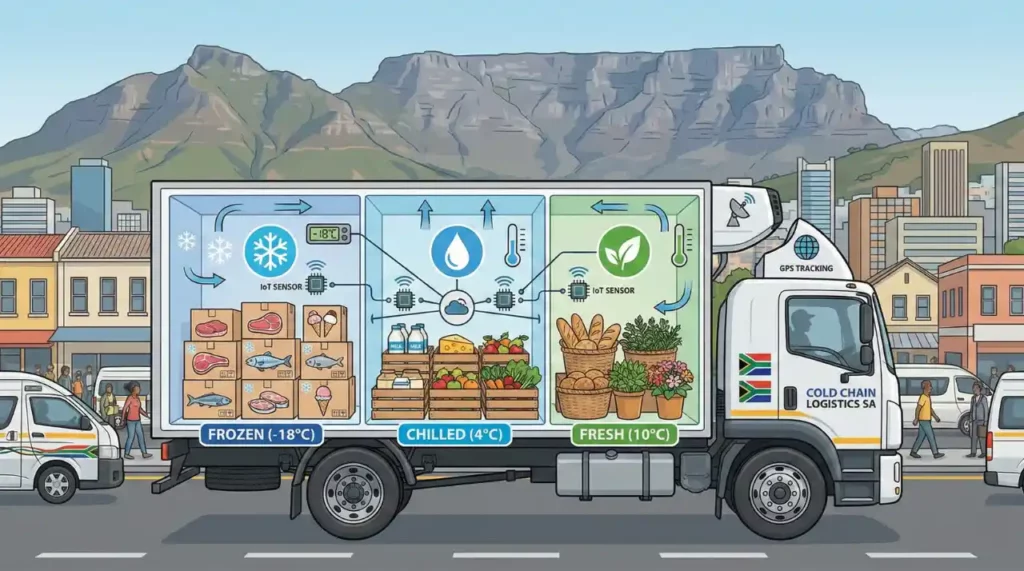
Cold chain management is the discipline that keeps temperature-sensitive products within safe limits from the moment they leave the farm or factory until they reach the end customer. In the context of food logistics in South Africa, cold chain management typically covers pre-cooling after harvest or processing, cold storage, refrigerated transport, and in-transit monitoring for export containers and reefers.
The PPECB provides cold chain management services to exporters, including inspection and approval of cold stores, containers, and specialised reefer vessels, as well as monitoring loading procedures and en-route temperature performance. This framework supports compliance with local regulations and bilateral agreements, while also helping industry to maintain South Africa’s reputation as a supplier of safe, high-quality perishable products.
From a commercial point of view, robust cold chain management can make or break food logistics in South Africa. Industry research shows that cold chain gaps are a major contributor to food waste, and that better monitoring and analysis of cold chain operations is essential if South Africa is to reduce both humanitarian and economic losses linked to spoiled food. At the same time, analysts estimate that the local cold chain and logistics market is already worth several billion US dollars, driven mostly by food and beverage volumes together with growth in pharmaceuticals and temperature-sensitive consumer products. Investing in cold chain management therefore supports regulatory compliance, but it also positions a business to participate in a growing, increasingly sophisticated logistics ecosystem.
Export-oriented businesses face an extra layer of complexity, because many destination markets prescribe specific carrying temperatures, time-temperature tolerances, and inspection regimes for different commodities, all of which are captured in formal regulations and export notices. In practice, this means food logistics in South Africa must ensure that handling procedures, set-points, and monitoring devices are aligned with both national standards and the requirements of target markets. For domestic and regional trade, the same cold chain discipline reduces product shrinkage and helps maintain shelf life, which is especially important for fresh produce, chilled ready meals, frozen goods, and premium dairy or beverage products that need to arrive in top condition.
To support this, many operators use technology such as remote temperature monitoring, telematics, and Internet of Things (IoT) sensors to manage cold chain performance across warehouses and fleets. These tools make it easier to track real-time conditions, generate alerts, and analyse historical trends, which is crucial in a market where long legs between inland regions and coastal ports can expose product to risk if there are delays or power interruptions. Effective cold chain management therefore becomes a core differentiator for companies competing in food logistics in South Africa, particularly those servicing export packhouses, national retailers, and food manufacturers who cannot afford repeated stock losses.
Refrigerated transport across a big country
Refrigerated transport is the workhorse of food logistics in South Africa, linking farms, factories, and distribution centres with retail outlets, wholesalers, and export terminals. Analysts note that refrigerated transport is one of the strongest sub-segments of the country’s cold chain and logistics market, driven largely by rising demand for perishable foods and growth in modern retail and e-commerce channels.
Because major production regions such as the Western Cape, Limpopo, and Mpumalanga are a long distance from ports and primary consumption centres, refrigerated transport fleets must be optimised for multi-temperature loads, backhauls, and high equipment utilisation. Fuel costs, driver availability, and road conditions all influence route planning, and these factors are magnified when vehicles must maintain strict temperature limits at the same time.
The rise of online meal delivery, frozen convenience foods, and temperature-controlled direct-to-consumer products adds further pressure to refrigerated transport networks. In many cases, long-haul refrigerated transport takes care of linehaul legs between cities or regions, after which cross-docking platforms, cold storage facilities, or urban depots handle break-bulk and redistribution into last-mile delivery channels. For logistics providers that specialise in food logistics in South Africa, this means it is no longer enough to offer basic reefer capacity; customers increasingly expect visibility, flexible loading options, temperature reporting, and the ability to integrate with their own supply chain systems and planning tools.
Last-mile delivery in South Africa’s food sector
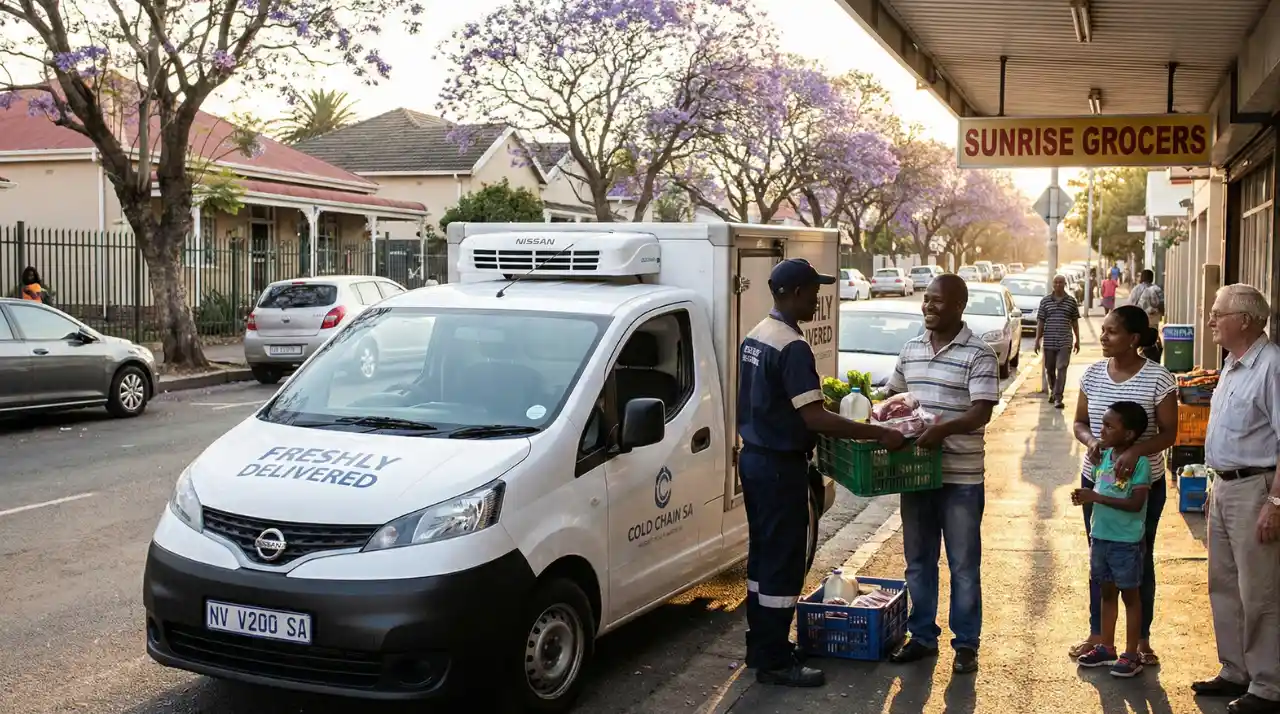
Last-mile delivery is where customers feel the performance of food logistics in South Africa most directly, whether they are ordering groceries online, receiving chilled stock at a restaurant back door, or accepting a pallet of frozen goods at an independent retail store. Research on omnichannel grocery operations in South Africa highlights four major sets of last-mile challenges: reliable order fulfilment, adherence to cold chain requirements, physical distribution constraints, and reverse logistics for returns or failed deliveries.
At the same time, analysis of the broader e-commerce landscape shows that last-mile logistics remains a pressure point, which is pushing retailers and logistics providers to experiment with new tracking, scheduling, and delivery models to keep customers happy.
In practice, last-mile delivery for food logistics in South Africa must account for dense urban areas, informal settlements, and lower-density townships, as well as smaller towns and rural communities where delivery volumes are thinner. Delivery networks need to balance speed and coverage with the realities of congestion, security, and operating costs, while also maintaining the integrity of refrigerated or frozen loads.
For some businesses, this may involve building micro-fulfilment hubs, dark stores, or cross-dock facilities closer to key demand pockets, so that last-mile delivery distances are reduced and vehicles spend less time in traffic. For others, partnerships with specialist last-mile operators, franchisees, or regional distributors make more sense, especially where volumes are still building and the economics of dedicated refrigerated fleets do not yet stack up.
Benefits of listing logistics-focused companies on Food & Beverage Trade South Africa
For logistics providers, cold stores, and related service companies, listing on Food & Beverage Trade South Africa is an effective way to plug directly into the national food and beverage ecosystem. The platform already serves as a bridge between South African producers and a wide range of trade buyers, including exporters, importers, wholesalers, and retailers, all of whom rely on food logistics in South Africa to move their products.
By positioning a logistics operation alongside producers and processors in authoritative directories and guides, businesses signal that they are serious about the sector, that they understand regulatory frameworks, and that they can support the specialised needs of food and beverage clients. This visibility is especially valuable for companies offering cold chain management, last-mile delivery, or refrigerated transport services, where trust and proven capability are essential.
Listing also supports lead generation and branding, because Food & Beverage Trade South Africa is actively used as a reference point by local and international buyers who want to understand the South African food value chain. When logistics and cold chain providers appear in these resources, they increase their chances of being shortlisted for contracts, cross-border projects, or new supply programmes.
Combined with a strong digital presence and participation in sector events, a listing becomes one more touchpoint that reminds procurement teams, technical managers, and supply chain leaders where to turn when they need partners for food logistics in South Africa.
For businesses further down the chain, such as wholesalers, food manufacturers, and retailers, using Food & Beverage Trade South Africa as a sourcing and reference tool also saves time. Instead of hunting around for fragmented information, buyers can access organised listings, contact details, and context on the broader value chain in one place, then quickly identify which service providers specialise in cold chain management, last-mile delivery, or refrigerated transport.
This fits neatly with a broader strategy of supply chain optimisation, where decision-makers combine directory insights with more detailed resources such as the SA food supply chain management guide and insights into overcoming South African supply chain challenges when shaping partnerships and logistics strategies.
Download one of the latest eBooks
To make it easier for industry professionals to navigate food logistics in South Africa, Food & Beverage Trade South Africa offers a set of downloadable eBooks that bring the country’s fresh, processed, and wine value chains together in one place. Fresh Food Trade SA focuses on the fresh food trade and supply chain, highlighting production regions, export data, and service providers linked to the fruit and vegetable sectors. Processed Food & Bev Trade SA covers the processed food and beverage supply chain, where cold chain management, refrigerated transport, and last-mile delivery are critical to maintaining quality from factory to shelf. Wines & Wineries of SA serves as a visitor’s guide to wine routes and cellars, while also offering insight into how logistics supports tourism, cellar door sales, and export distribution.
Downloadable eBooks give busy professionals a practical way to explore food logistics in South Africa offline, share information across teams, and identify gaps or opportunities in their own networks. Because these publications also showcase service providers and enable businesses to register for inclusion in future editions, they double as both reference tools and marketing platforms. The call to action is straightforward for logistics and cold chain companies: download one of the latest eBooks, review where current strengths and gaps lie, and then secure a listing so that potential partners can find the business easily when they are planning routes, suppliers, or export programmes.
Food & Beverage Trade South Africa at a glance
Food & Beverage Trade South Africa functions as a comprehensive directory, publisher, and online platform for the country’s food and beverage trade and supply chain. Its annual guides, including Fresh Food Trade SA, Processed Food & Bev Trade SA, and Wines & Wineries of SA, have evolved into trusted reference points for producers, exporters, logistics providers, and overseas buyers who want a structured view of the South African market. Beyond print and PDF, the platform’s website hosts in-depth articles on topics such as local food supply chains, processed food logistics, and strategies for overcoming infrastructure and regulatory hurdles, all of which intersect with the day-to-day realities of food logistics in South Africa.
For logistics operators, cold storage providers, and value-added service companies, this multi-channel presence offers an opportunity to be visible wherever buyers are doing their homework, whether that is paging through a printed directory, downloading an eBook, or reading a supply chain article online. For buyers and supply chain managers, Food & Beverage Trade South Africa simplifies the task of understanding who does what within food logistics in South Africa, and how those capabilities connect to production regions, product categories, and export markets. Used together with official resources such as cold chain management guidance for exporters and the South African government’s overview of agriculture and perishable export oversight, the platform helps professionals build a more complete and actionable picture of the sector.
In short, Food & Beverage Trade South Africa sits at the crossroads of information, regulation, and commercial opportunity. It highlights the importance of cold chain management, last-mile delivery, and refrigerated transport, while also providing a practical route for businesses to position themselves in the wider ecosystem of food logistics in South Africa. For organisations that want to grow in this market, engaging with the platform, downloading its eBooks, and securing a listing are sensible next steps that support both visibility and long-term resilience.