Introduction
Just before six in the morning, a small Stellenbosch producer of artisanal sauces checks a delivery of glass jars against an order sheet, then turns to a batch of rooibos-infused marinade cooling on stainless steel counters. A courier is due within the hour, carrying stock bound for a foodservice buyer who has asked, for the first time, for proof of supplier checks before signing a repeat order. The request is not personal. It reflects a wider shift in the market: food fraud prevention has moved from a niche compliance topic to a basic condition of doing business with serious buyers in South Africa. For a small manufacturer running a handful of staff and a few retail accounts, that shift can feel sudden, but meeting it does not need to be expensive or complicated.
Table of Contents:
TL;DR: Key Takeaways
- Food fraud is deception for financial gain; food defence is protection against deliberate tampering. They are different risks that need different controls.
- A basic food defence plan does not require a consultant. It needs a simple site walk-through, a documented risk list, and a routine review date.
- Traceability, through batch coding and one-up-one-down records, is the single most useful tool for food fraud prevention and faster recalls.
- A supplier vetting checklist food buyers can trust turns supplier decisions into evidence-based choices rather than guesswork.
- South Africa’s own food safety history, including the world’s largest recorded listeriosis outbreak, is a large part of why buyers now expect documented proof before extending trust.
What food fraud and food defence actually mean for a small producer
Food fraud and food defence sound alike, and SME owners often use the terms as if they mean the same thing. They do not. Food fraud covers the deliberate misrepresentation, substitution, or adulteration of a product for financial gain, whether that means diluting an ingredient, mislabelling origin, or passing off an inferior substitute under a premium name. Food defence covers deliberate, malicious contamination of food, motivated by intent to cause harm rather than profit, such as tampering by a disgruntled employee or an outside party.
Food fraud is deception for profit
A small manufacturer of sauces and marinades carries food fraud risk mainly through inputs. Rooibos, chilli, vinegar, and rendered fat sourced from third parties can be substituted with cheaper alternatives without an obvious change in appearance, and a busy production line rarely has time to test every incoming batch. The commercial incentive for a supplier to cut corners rises whenever input costs climb, which makes food fraud prevention a live concern rather than a theoretical one for any South African producer buying from multiple third parties.
Food defence is protection against deliberate harm
Food defence sits closer to security than to quality control. It asks who could get physical or procedural access to a product before it reaches a buyer, and what could turn that access into harm. Certification schemes used by many South African retailers and exporters, including BRCGS and FSSC 22000, require a documented food defence plan and a food fraud vulnerability assessment before they will approve a site. Even a business that has not yet pursued formal certification benefits from thinking through both risks early, because retrofitting controls after a buyer complaint is slower and more expensive than building them in from the start, and vetting suppliers upfront with a supplier vetting checklist for food suppliers reduces exposure to both risks at once.

Why the risk is real in South Africa right now
South Africa has direct experience of what happens when food safety and food integrity controls fail at scale. Between January 2017 and mid-2018, the country recorded the world’s largest documented listeriosis outbreak, traced back to a ready-to-eat processed meat production facility, according to situation reports published by the National Institute for Communicable Diseases. Before that outbreak, the country averaged around 60 to 80 confirmed listeriosis cases a year; case numbers climbed into the hundreds before the source was identified and the implicated products were recalled. The event reshaped how retailers and export buyers approach supplier proof, and it remains one of the clearest reasons South African buyers now ask small producers for documented controls before signing a contract.
Food fraud follows a separate but related pattern. A review of South Africa’s food control and safety landscape, led by researchers at the University of Johannesburg and published in BMC Public Health, points to testing of processed meat products that uncovered undeclared animal species in a majority of samples tested, with pork and chicken the most frequently substituted meats and soya or gluten the most common undeclared plant proteins, drawing on earlier South African meat-testing research (see the BMC Public Health review of South Africa’s food safety landscape for the full analysis). The same review notes that penalties for food safety offences under the Foodstuffs, Cosmetics and Disinfectants Act remain low by international standards, which weakens the deterrent effect for larger operators able to treat a fine as a routine cost. For a small, reputation-dependent producer, that gap in enforcement is exactly why internal food fraud prevention controls carry more weight than hoping regulators catch a bad supplier first.
The five weak points where SMEs are most exposed
Most food fraud and food defence incidents at small manufacturers trace back to a handful of predictable weak points, not to elaborate criminal plots. Recognising them is the first step toward a workable food defence plan. The five points below run from raw materials through to final dispatch, and most small producers already have partial controls in place for at least two or three of them.
- Raw material substitution: unverified ingredient swaps at the supplier end, especially for higher-value inputs such as specialty spices, oils, or flavour extracts.
- Incoming goods verification: accepting deliveries without checking certificates of analysis, batch numbers, or seals against what was actually ordered.
- Staff and site access: unrestricted access to production and storage areas by staff, contractors, or visitors without sign-in or supervision.
- Packaging and tamper evidence: reused containers, weak seals, or labels that do not clearly show whether a pack has already been opened.
- Storage and distribution handovers: gaps in temperature and custody records between the production site, third-party stores, and couriers.
The storage and distribution weak point above deserves particular attention, since it is the point where a product leaves direct oversight. A warehouse compliance checklist for South African food storage sets out the paperwork, from certificates of acceptability to temperature and traceability records, that buyers and auditors expect a storage partner to produce on request.
Building a basic food defence plan without a consultant’s budget
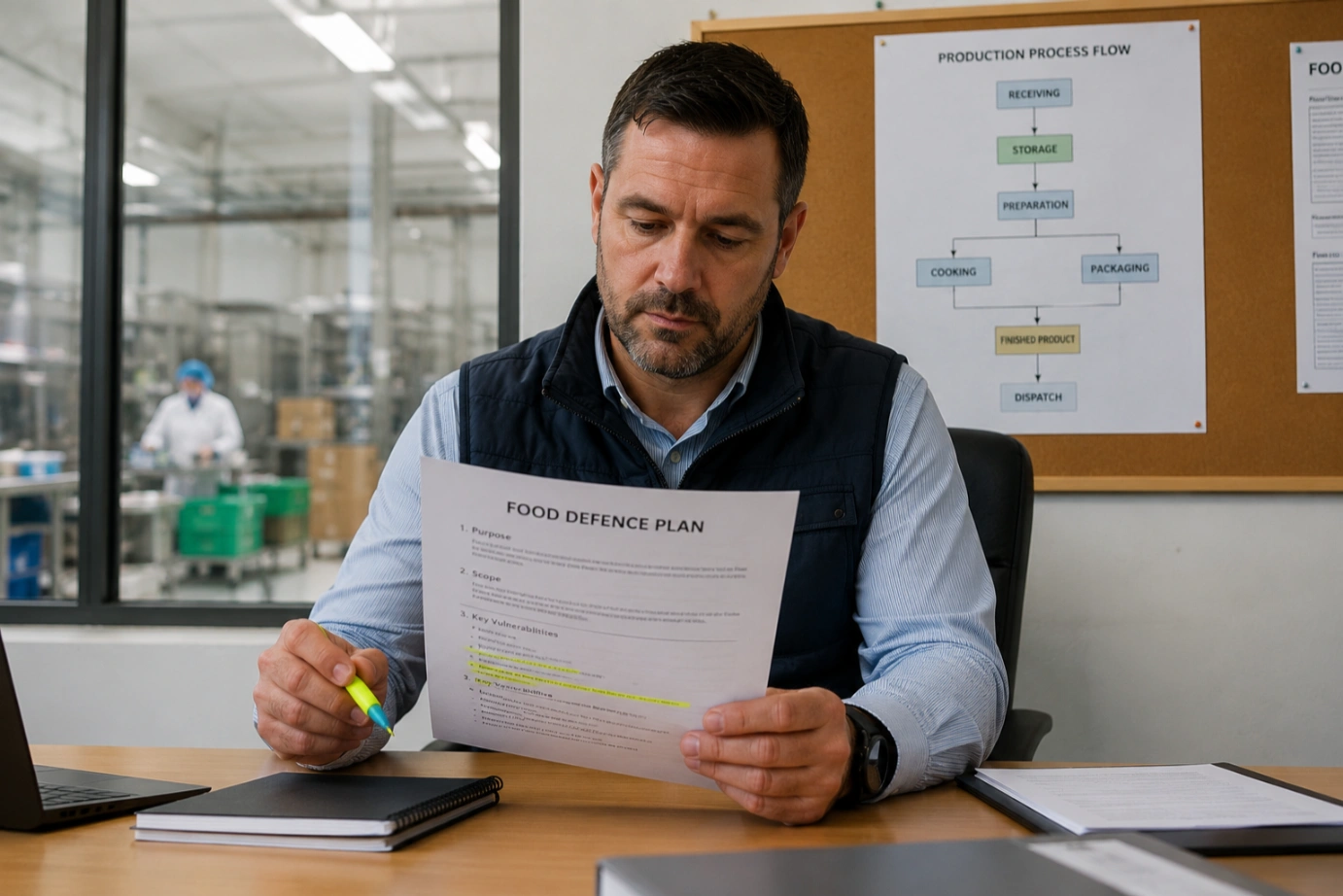
A food defence plan does not need to run to fifty pages or carry a large consulting fee. It needs to answer four questions in a way that can be shown to a buyer or auditor on request. Each step below builds on the last, starting with a simple process map and ending with a review routine that keeps the plan useful rather than decorative.
Step 1: Map the process
Draw the production process from goods-in to dispatch, noting every point where a person could physically touch a product or its packaging. Include third-party storage and transport handovers on the same map, since these sit outside daily supervision but still carry risk. This does not require specialist software; a single page with boxes and arrows is enough for most small operations, and it becomes the reference document for every later step.
Step 2: Identify who could interfere and how
For each point on the map, note who has access and what could go wrong deliberately, kept separate from accidental contamination risks already covered by existing food safety procedures. This is where food fraud and food defence risks get assessed side by side, since both hinge on access and opportunity rather than on equipment failure. A short list naming two or three realistic scenarios per point is more useful than an exhaustive theoretical review that never gets finished.
Step 3: Write the controls down
Match each risk to a specific control, such as locked storage for high-value ingredients, sign-in logs for visitors, tamper-evident seals on finished product, or a second person checking incoming certificates of analysis. The document does not need technical language. It needs to be specific enough that another staff member could follow it without asking questions.
Step 4: Review after any change
Update the plan whenever a supplier, packaging format, or site layout changes, and revisit it at least once a year even if nothing obvious has shifted. Buyers increasingly ask to see the review date on a food defence plan, not only its existence, because a document untouched for three years signals a box-ticking exercise rather than a living control. Keeping the review log on the first page of the document makes this easy to demonstrate during a site visit.
Traceability as the backbone of food fraud prevention
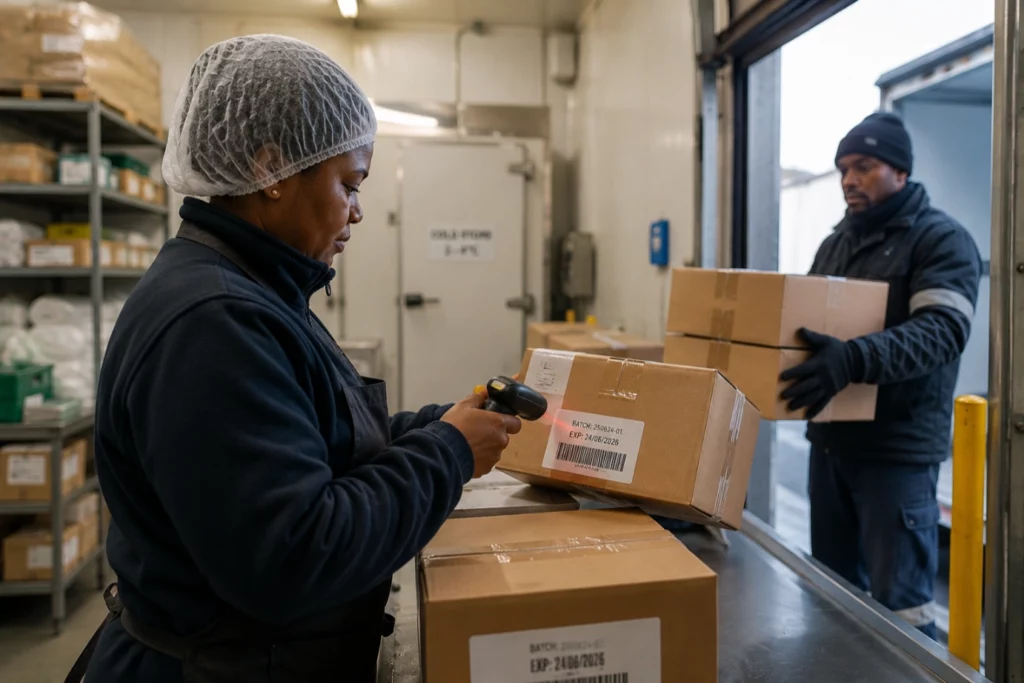
Traceability is the single control that does the most work across both food fraud and food defence, and it is also the one South African buyers check first. A batch coding system that links raw materials to finished product, paired with one-up-one-down records showing what came in and what went out, lets a producer answer a recall question in minutes rather than days. Retailers and export buyers increasingly treat this as a non-negotiable baseline rather than a nice-to-have, in line with the R638 food premises requirements that govern food handling and storage sites.
Labelling accuracy sits alongside traceability as a frontline defence against both accidental and deliberate misrepresentation. A food label compliance checklist South Africa that covers ingredient declarations, allergen statements, and batch or lot coding gives a producer a repeatable way to catch drift before a buyer does. Getting this right at the labelling stage also reduces the chance that a genuine formulation change gets mistaken for fraud during a routine audit, which is a common and avoidable source of friction between small producers and retail quality teams.
A practical food defence checklist for small food manufacturers
The following food defence checklist for small food manufacturers condenses the controls above into a working list that can be reviewed in under an hour. It is not exhaustive, but it covers the checks that buyers and auditors return to most often. Working through it once a quarter takes less time than handling a single supplier dispute after the fact.
- Written food defence plan on file, reviewed within the last twelve months.
- Batch coding applied to every production run, linked to raw material lot numbers.
- One-up-one-down traceability records for incoming ingredients and outgoing finished product.
- Certificates of analysis checked against delivery documents for every incoming batch of high-risk ingredients.
- Sign-in log and supervision policy for visitors and contractors in production areas.
- Tamper-evident seals applied to all finished product leaving the site.
- Locked or restricted storage for high-value or easily substituted ingredients.
- A named person responsible for reviewing and updating the food defence plan.
What buyers expect to see before they trust a new supplier
Retail and foodservice buyers rarely ask for a food defence plan by that exact name in a first conversation. They ask for proof: certificates, batch records, and a clear answer to how a product would be traced and recalled if something went wrong. A step-by-step guide to listing in a South African food directory sets out the kind of documentation buyers expect before a supplier reaches a shortlist, and it overlaps closely with the food fraud and food defence basics covered here.
A supplier vetting checklist works in both directions. Buyers use it to assess new producers, and producers can use the same logic internally to assess their own raw material suppliers. Treating supplier vetting as a two-way discipline, rather than something only buyers do to producers, tends to catch weak links earlier and builds a stronger case when a producer is the one being assessed for a listing.
Conclusion
Food fraud prevention and a working food defence plan are not separate projects reserved for large manufacturers with compliance departments. They are a short list of specific, low-cost habits: verified inputs, restricted access, tamper-evident packaging, and traceability records that can answer a recall question in minutes. For a small South African producer working toward a national retail listing or an export order, those habits are increasingly the price of entry rather than an optional extra, and building them early costs far less than repairing a buyer relationship after a supplier scandal.
FAQ
What is the difference between food fraud and food defence?
Food fraud involves deliberate deception for financial gain, such as substituting or mislabelling ingredients. Food defence involves protecting food from deliberate, malicious tampering intended to cause harm rather than profit. Food fraud prevention and food defence use overlapping controls but respond to different motives.
Does a small food manufacturer really need a written food defence plan?
Yes, particularly for producers supplying retail, foodservice, or export buyers. Many buyers and certification schemes now expect a documented food defence plan as a condition of listing, and having one ready before it is requested speeds up onboarding.
What is the fastest way to start food fraud prevention on a limited budget?
Start with supplier verification and traceability. Checking certificates of analysis against deliveries and applying consistent batch coding catches most common fraud risks without specialist equipment or consulting fees.
How often should a food defence plan be reviewed?
At least once a year, and immediately after any change to suppliers, packaging, or site layout. Buyers increasingly check the review date, not only the existence of the document.
What documents do South African buyers typically ask for during supplier vetting?
Certificates of analysis, batch and traceability records, food safety certification where applicable, and evidence of a documented food defence approach. A supplier vetting checklist food buyers use often mirrors the same list a producer should keep on file internally.
Is food fraud a serious problem in South Africa specifically?
Independent South African research has documented meaningful levels of ingredient substitution in processed meat products sold locally, alongside recognised gaps in enforcement. This makes internal food fraud prevention controls a practical priority rather than an overcautious one.
Can traceability alone prevent food fraud?
Traceability will not stop a determined fraudster on its own, but it dramatically shortens the time needed to find and isolate a problem once one is suspected. Paired with supplier vetting and tamper-evident packaging, it forms the core of a workable food fraud prevention approach for small producers.